High-Quality Wholesale Blankets Manufacturer & Supplier in China with custom design service - Blue Phoenix Blankets
Language
The TBH2101 85% acrylic 15% polyester blanket provides a heavyweight synthetic option for buyers developing relief, institutional and accommodation supply programs. Its defined composition, generous dimensions and substantial piece weight give procurement teams a clear starting point for sample evaluation and quotation comparison.
For professional buyers, the material name is only the beginning. Coverage, handling weight, edge construction, cleaning requirements and packing volume should be reviewed together before approving a bulk blanket order.
This guide explains how to evaluate TBH2101 and prepare a purchasing specification that connects the sample, quotation and finished delivery.
Understanding the 85% Acrylic 15% Polyester CompositionTBH2101 uses an overall composition of 85% acrylic and 15% polyester. The listed construction uses polyester warp yarn and acrylic weft yarn.
These descriptions explain different aspects of the same product: the overall percentage identifies the blanket composition, while the warp and weft information describes the yarn arrangement.
Buyers searching for an 85acrylic 15polyester blanket should confirm the complete composition rather than relying on a general description such as “synthetic blanket” or “wool-like blanket.”
TBH2101 is not a wool blanket. Its composition should remain consistent across the quotation, sample record, purchase order, labels and product description.
If independent composition verification is required, agree on representative sampling, testing arrangements and documentation before production approval.
Size, Weight and CoverageThe published TBH2101 specification lists 160 × 240 cm dimensions and an approximate finished weight of 2750 g per piece.
This makes piece weight an important part of the purchasing decision. Buyers should assess the blanket opened, folded and packed rather than judging its suitability from a product photograph alone.
For an institutional blanket, check whether the dimensions provide the required bed coverage. For a distribution program, assess handling, individual packing and carton weight.
A heavier product should not automatically be described as lightweight or inexpensive to transport. The appropriate choice depends on the complete delivery and use arrangement.
Final dimensions, weight tolerances and measurement methods should be recorded in the order specification.
Surface Appearance and Edge ConstructionThe featured blanket has a plain neutral appearance, a dense brushed surface and coordinated overlock edges.
During sample review, examine the surface in several areas rather than checking only one corner. Compare texture, visible irregularities, loose fibers and overall drape against the approved reference.
Overlock finishing should be inspected for stitch consistency, skipped stitches, loose ends and corner appearance. The edge should match the construction shown in the approved sample.
Marketing images should retain the actual product identity. Adding fringe, satin binding, decorative stripes or a different surface texture would present a different blanket.
For repeat orders, retain a physical reference sample so that shade, surface and finishing can be compared consistently.
Evaluating TBH2101 for Institutional AccommodationAn accommodation blanket should be selected around the conditions in which it will be used.
Procurement teams should consider bed dimensions, user coverage, preferred weight, room conditions and the cleaning process. The same product may be assessed differently for staff housing, dormitory bedding or a temporary accommodation project.
Care requirements are especially important where blankets will be cleaned repeatedly. Do not assume compatibility with a commercial laundry process solely because the blanket contains synthetic fibers.
Ask the supplier and laundry operator to review the intended process. Where necessary, evaluate the sample after an agreed number of cleaning cycles and inspect dimensions, appearance, edges and surface condition.
Relief and Emergency Supply ConsiderationsFor relief blanket procurement, coverage and material specifications should be considered alongside packing and distribution requirements.
TBH2101 can be evaluated when a heavyweight acrylic-polyester construction matches the purchasing brief. Buyers should confirm whether its piece weight and packed volume suit the intended transport and distribution method.
A disaster-response program may have specific requirements for dimensions, thermal performance, labeling, packaging or documentation. Those requirements should be provided before sampling.
Neither the term “relief blanket” nor the material composition establishes compliance with a humanitarian purchasing specification.
For repeat supply, a documented reference helps keep the blanket consistent across different production batches.
Military and Correctional Procurement Require Specific ReviewA military accommodation blanket or correctional facility blanket must be assessed against the buyer’s actual requirements.
Standard TBH2101 should not be presented as certified flame resistant, anti-ligature, antibacterial or suitable for a specific outdoor temperature without supporting evidence.
Similarly, a substantial blanket weight does not establish specialist protective performance.
Where a project requires particular testing, provide the applicable method and acceptance criteria before order confirmation. Testing feasibility, sample preparation, cost and timing can then be reviewed.
This approach gives buyers a clearer basis for approval than broad descriptions such as “military grade” or “all-weather performance.”
Compare Packing and Delivered CostA useful wholesale blanket quotation should identify more than the unit price.
Confirm individual packing, pieces per carton, carton dimensions, net weight, gross weight and shipping marks. These details affect receiving, storage and transport planning.
Compare FOB, CIF or DDP offers using equivalent product and packaging specifications. Freight costs depend on the destination, shipment size, weight and transport arrangements.
For a heavyweight blanket, request the packing information early enough to assess the delivery plan before approving the order.
Customized packaging should be included in the sample and quotation process rather than added after bulk production has started.
Sampling, Customization and Quality ControlBLUE PHOENIX supports discussions about custom blanket dimensions, colors, labels and packaging, subject to production review.
A complete development brief should identify which parts of the standard specification will remain and which will change. MOQ, pricing and timing depend on that confirmed brief.
Sample and courier charges apply. Review the sample for composition requirements, dimensions, weight, shade, surface, stitching, labels and packaging.
Where third-party inspection is required, services such as SGS inspection can be discussed. Inspection arrangements are separate from product certification.
Standard payment terms are 30% deposit and 70% before shipment, subject to the confirmed agreement.
ConclusionTBH2101 offers a clearly defined 85% acrylic 15% polyester blanket specification for professional buyers evaluating heavyweight relief and institutional bedding.
The strongest purchasing decision combines the material specification with sample approval, suitable care arrangements, documented inspection criteria and a realistic packing plan.
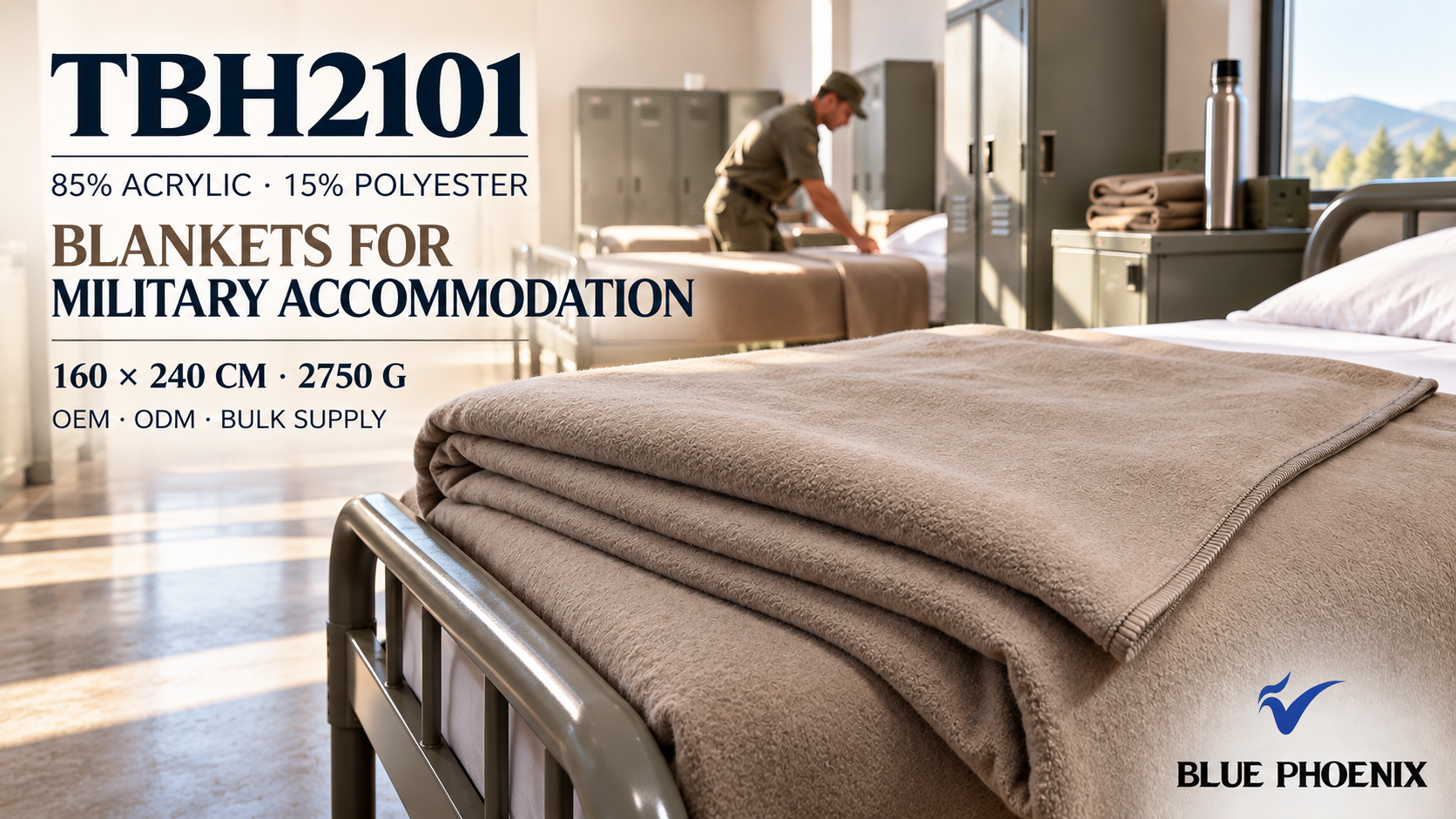
TBH2101 taupe acrylic polyester blanket with matching overlock edges, folded on a bed in military accommodation.
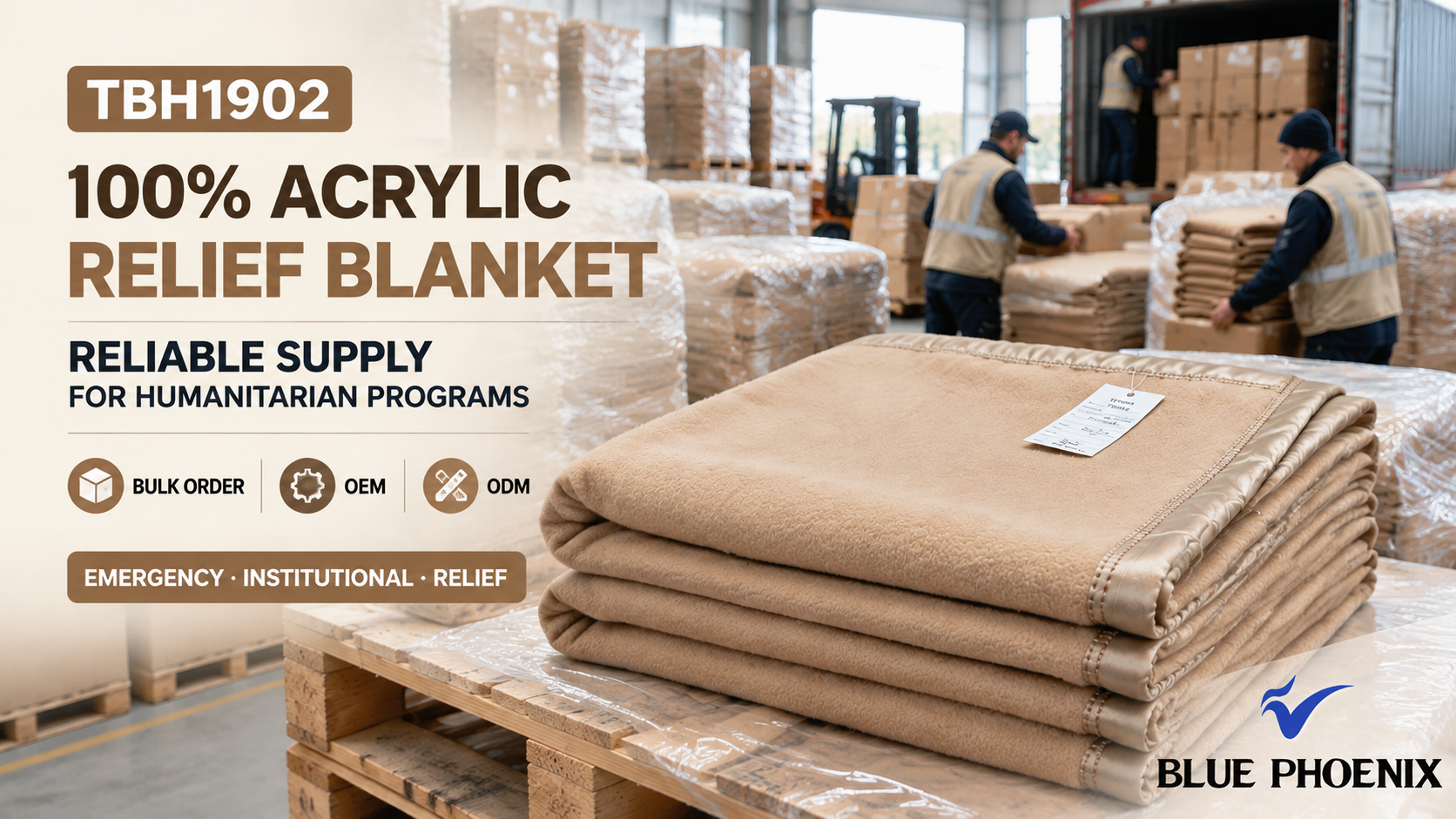
TBH1902 beige acrylic relief blankets stacked on a wooden pallet in an export warehouse during shipment preparation.
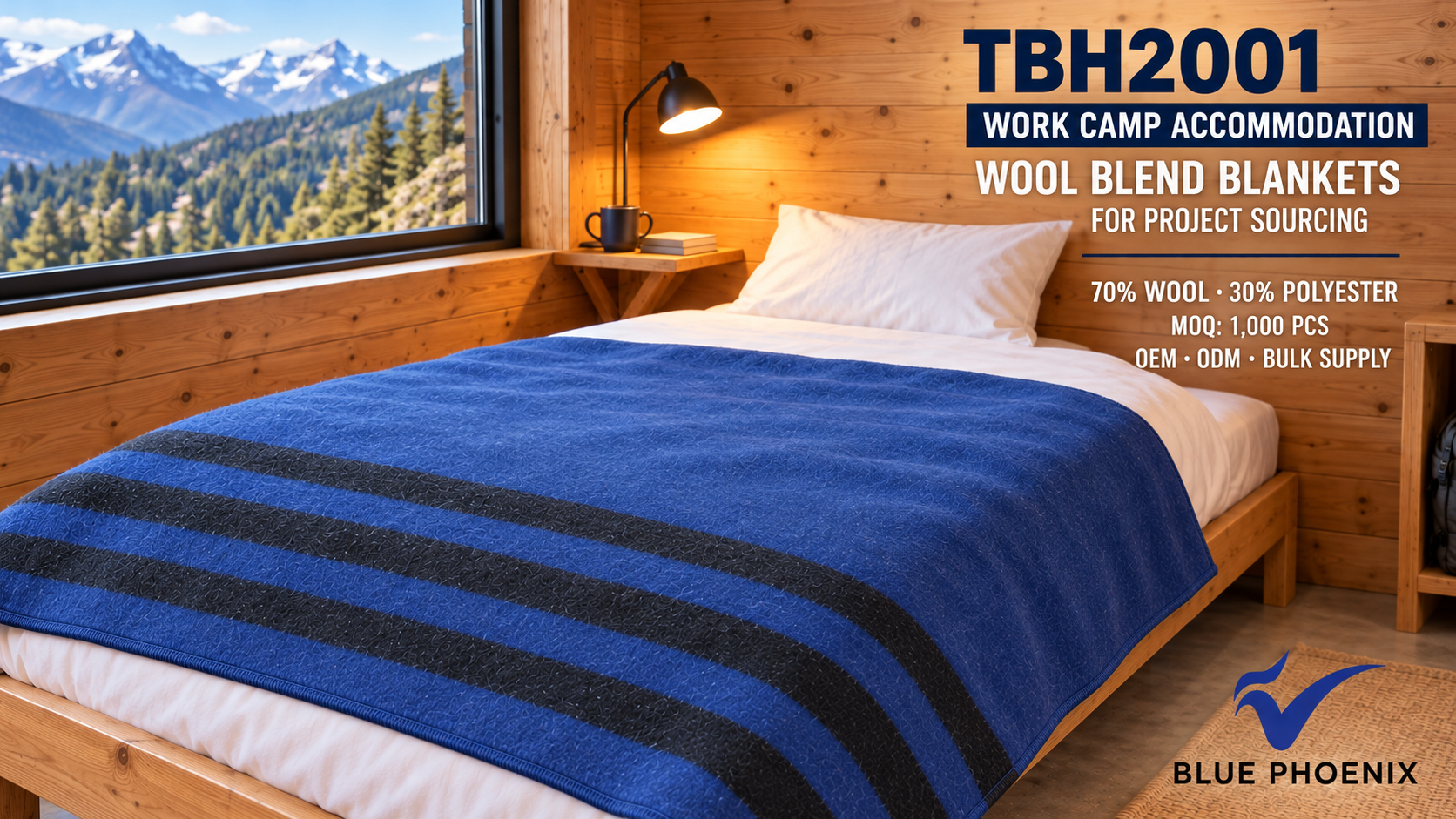
TBH2001 blue wool blend blanket with three black stripes, spread across a bed in mountain work-camp accommodation.
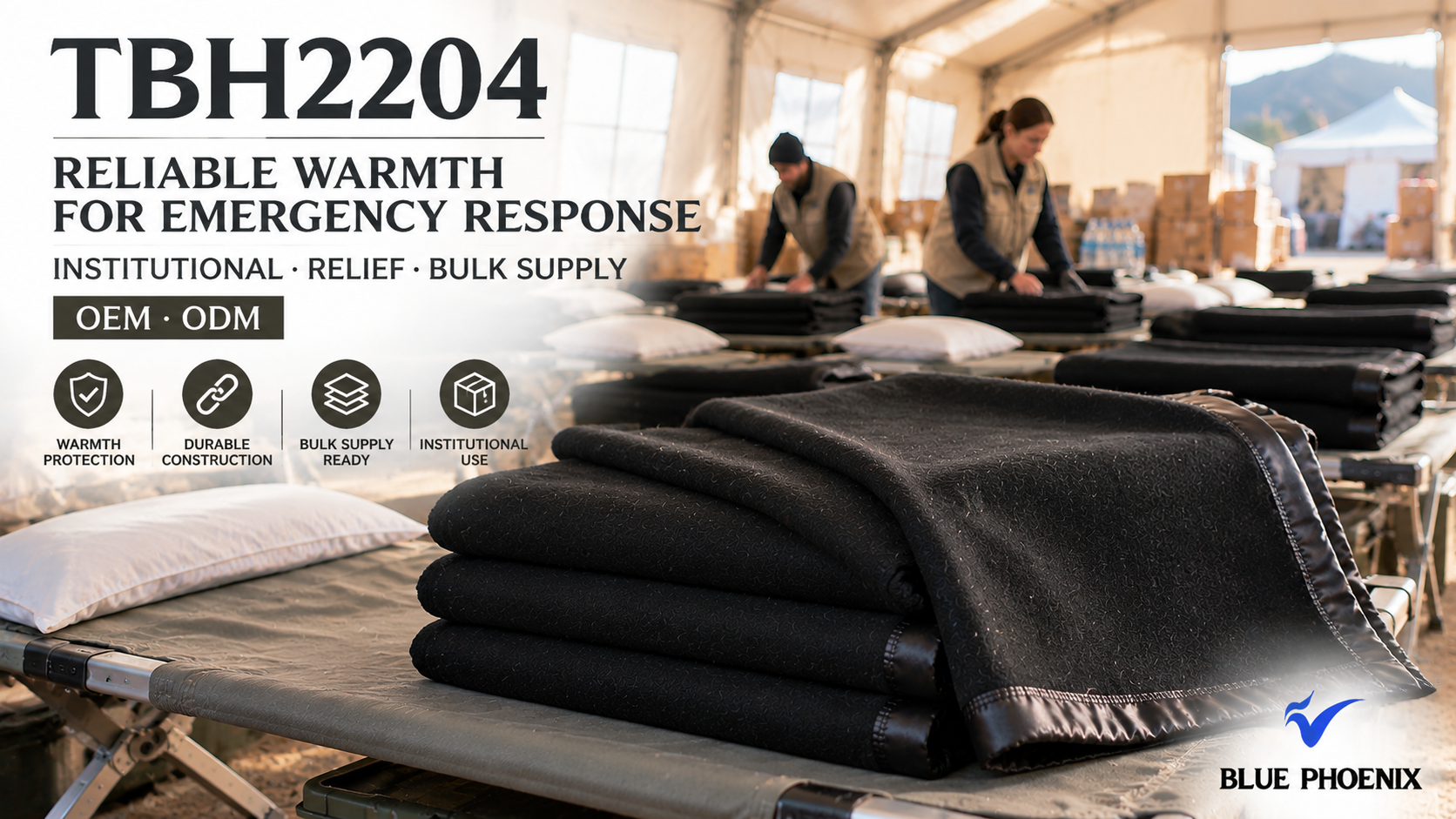
TBH2204 dark wool blend blankets with satin binding, stacked on a preparation table in a temporary accommodation facility.
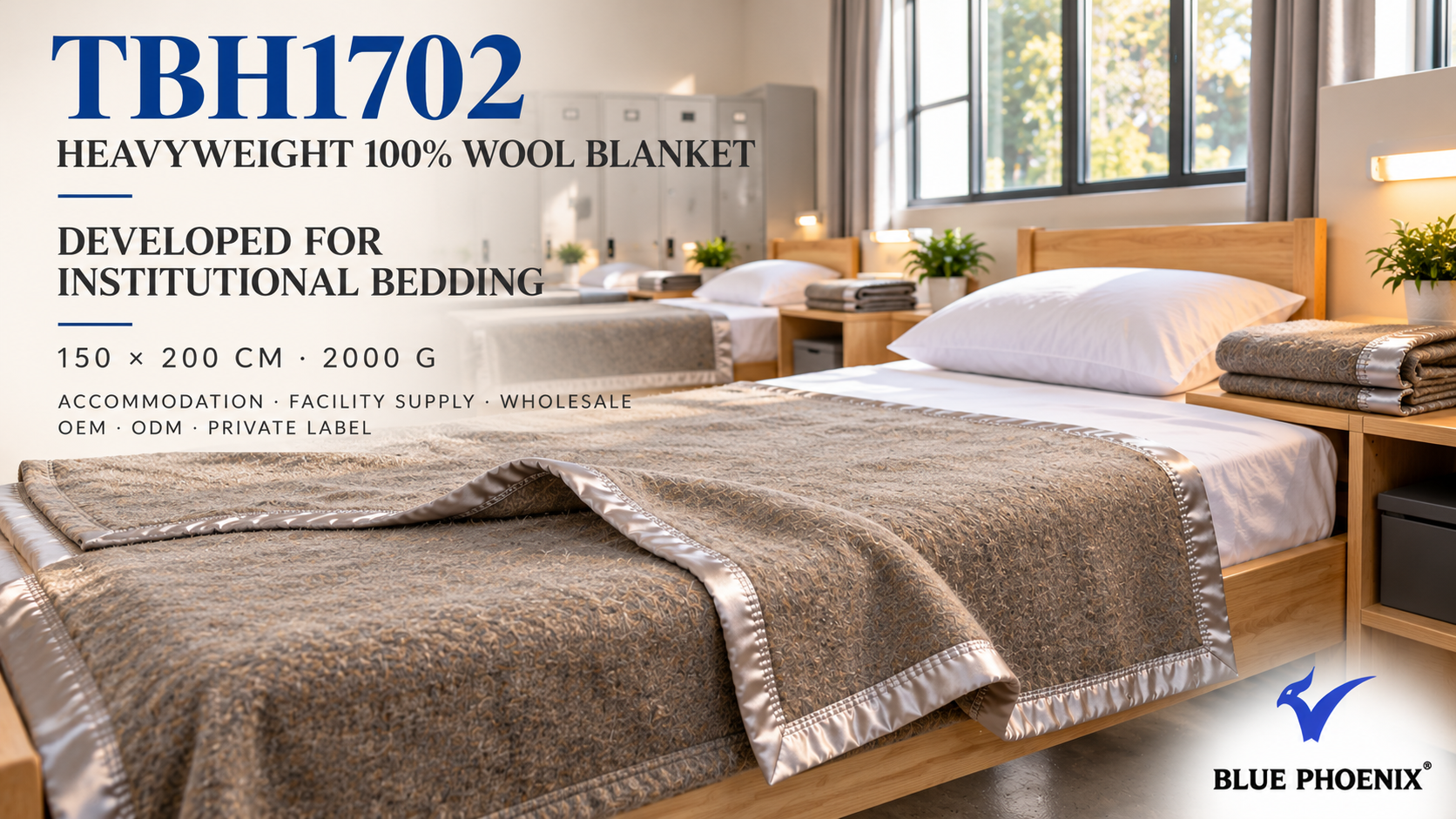
TBH1702 grey-brown wool blanket with coordinated satin binding, arranged across a bed in a bright institutional bedroom.
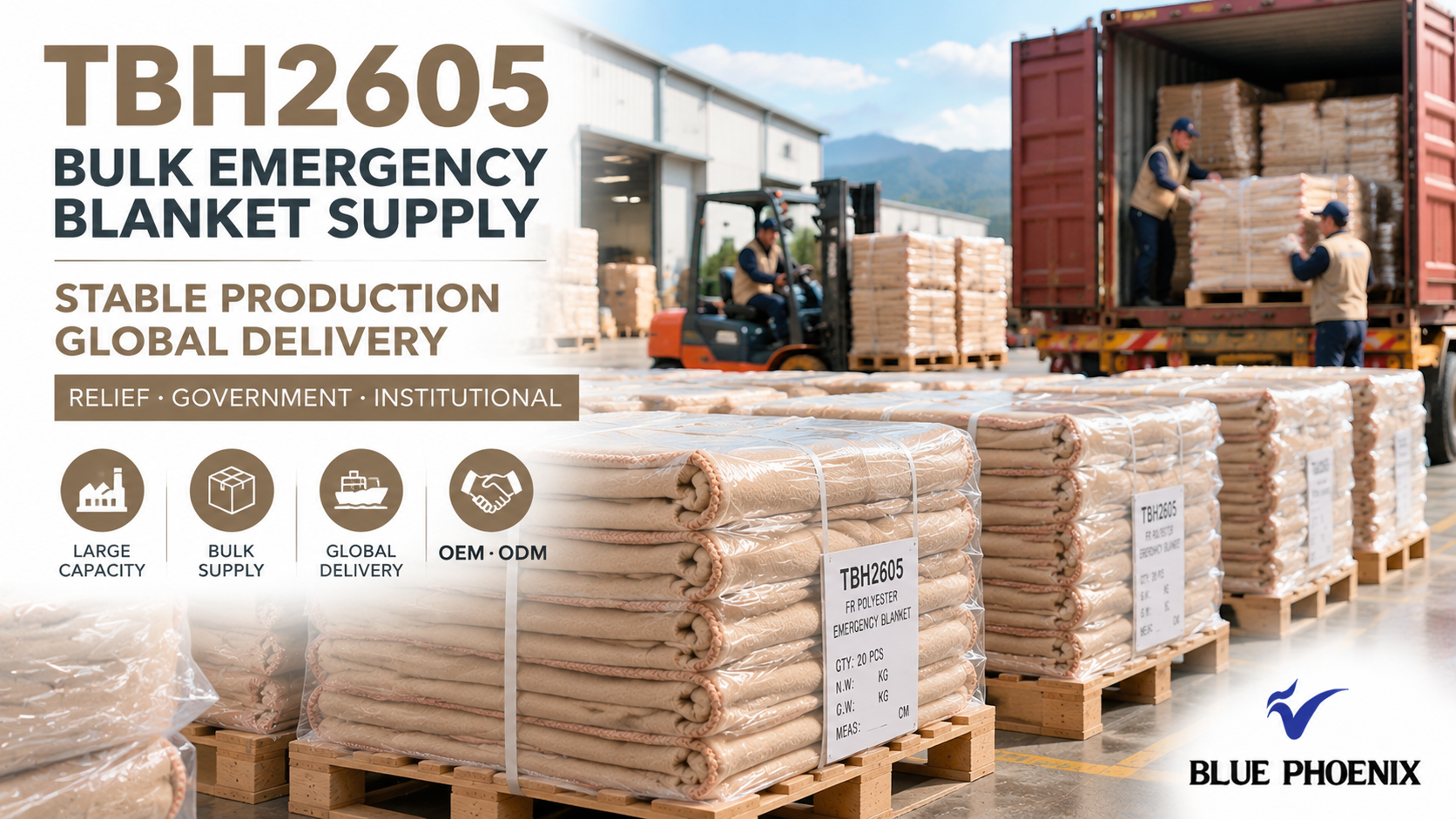
TBH2605 flame-retardant polyester blankets prepared for bulk emergency relief and institutional supply, with export packaging and customized labeling options.
1. What is TBH2101?
TBH2101 is a heavyweight 85% acrylic and 15% polyester blanket offered by BLUE PHOENIX for evaluation in relief, institutional and accommodation supply projects.
2. How should buyers determine whether TBH2101 suits their project?
Compare the sample with the required composition, bed coverage, handling weight, cleaning process, packaging and any specified performance criteria.
3. What is the MOQ for TBH2101?
MOQ must be confirmed against the requested dimensions, color, labels, packaging and other development requirements.
4. Can TBH2101 be customized?
Custom dimensions, colors, labels and packaging can be discussed. Feasibility, sampling, pricing and production timing require confirmation.
5. Are samples and courier services free?
No. Sample and courier charges apply. Confirm the sample specification, cost and dispatch arrangements before proceeding.
6. What quotation and payment terms are available?
FOB, CIF and DDP quotations can be discussed according to the shipment. Standard payment terms are 30% deposit and 70% before shipment, subject to the confirmed agreement.
1. What is the composition of TBH2101?
The overall composition is 85% acrylic and 15% polyester.
2. What does 85acrylic 15polyester mean?
It is a compact way of describing the 85% acrylic and 15% polyester blend. Formal specifications should state the full fiber names and percentages.
3. Is TBH2101 a wool blanket?
No. Its stated composition contains acrylic and polyester rather than wool.
4. How are the warp and weft specified?
The listed construction uses polyester warp yarn and acrylic weft yarn. The overall composition remains 85% acrylic and 15% polyester.
5. What are the published dimensions?
The published reference size is 160 × 240 cm. Confirm final dimensions and tolerances in the order specification.
6. What is the published piece weight?
The reference finished weight is approximately 2750 g per blanket.
7. Is TBH2101 lightweight?
It is presented as a heavyweight blanket. Buyers should evaluate handling weight and packed volume for their project.
8. What should buyers inspect on the brushed surface?
Check surface uniformity, visible irregularities, loose fibers, texture and consistency against the approved sample.
9. How are the blanket edges finished?
The featured product uses coordinated overlock finishing. Inspect stitching and corners during sample approval.
10. Can TBH2101 be washed commercially?
Do not assume compatibility with a commercial laundry process. Confirm the approved care instructions and evaluate the intended process where required.
11. Is TBH2101 certified flame resistant?
No flame-resistant certification is claimed in this guide. Provide any required testing standard for project-specific review.
12. Is TBH2101 an anti-ligature blanket?
No anti-ligature performance is established here. Specialist correctional safety requirements require separate product assessment.
13. Does the blanket have a certified outdoor temperature rating?
No temperature rating is established by its composition or piece weight alone.
14. Can it be considered for relief distribution?
Yes, when its specification matches the procurement brief. Review coverage, packing, handling and required documentation before approval.
15. What carton information should importers request?
Request pieces per carton, carton dimensions, net weight, gross weight and shipping marks.
16. Which quality checks should be agreed before production?
Agree on composition requirements, dimensions, weight, shade, surface appearance, stitching, labels, packaging and acceptance tolerances.
17. Can third-party inspection be arranged?
Inspection services such as SGS inspection can be discussed. The scope, cost and timing should be agreed in advance.
18. How long does production take?
The final schedule depends on the approved specification, quantity, material availability, sampling and packaging requirements.
19. How can repeat orders remain consistent?
Retain approved samples and written specifications, and inspect later production against agreed tolerances.
20. What should a TBH2101 inquiry include?
Include the intended application, quantity, dimensions, weight, color, labels, packaging, testing requirements and delivery destination.
Relief & Refugee Blankets — Explore products for project-specific emergency supply requirements.
Institutional Blankets — Compare bedding options for organized accommodation.
Acrylic Blankets — Review acrylic-containing options and confirm each model's composition.
Army Blankets — Explore products for military accommodation procurement.
Compare the following products against your purchasing brief. They have different compositions and should not be treated as equivalent specifications.
TBH2101 85% Acrylic / 15% Polyester Blanket — The featured heavyweight synthetic option.
TBH1902 100% Acrylic Relief Blanket — An alternative acrylic composition for comparison.
TBH2001 Wool Blend Military Blanket — A wool-polyester alternative for accommodation projects.
TBH2204 Heavyweight Wool Blend Blanket — A blended option with bound edges.
TBH1702 100% Wool Military Blanket — A pure-wool option for separate specification review.
TBH2605 Flame-Retardant Polyester Emergency Blanket — Made from flame-retardant polyester, with a sand-beige brushed surface and overlock edges, for emergency relief and institutional blanket procurement.
For a broader sourcing checklist, read the Military Blanket Manufacturer Guide.
Contact James at BLUE PHOENIX with your required composition, dimensions, weight, quantity, packaging and destination. We can discuss sample evaluation, wholesale supply, OEM/ODM development and FOB/CIF/DDP quotations. Sample and courier charges apply.
Email: jamesli@shbluephoenix.com
WhatsApp: +86 18017830390
WeChat: bluephoenix66
Website: https://www.shbluephoenix.com/

Blue Phoenix Blankets dedicated to strict quality control of blankets and scarves products and thoughtful customer service, our custom blankets wholesale products are exported to clients in such countries and regions as United states, Europe, Australia, Russia, Germany, Japan.
Copyright © 2026 Shanghai Rainbow Enterprise Development Co., Ltd. - All Rights Reserved.