High-Quality Wholesale Blankets Manufacturer & Supplier in China with custom design service - Blue Phoenix Blankets
Language
A yak blanket can bring natural color, woven or knitted texture and a distinctive material story to a home-textile collection. However, the words “yak wool” alone do not explain how a finished blanket will feel, how much coverage it provides or how it should be cared for.
Choosing well means looking at fiber selection, composition, construction, dimensions, weight and finishing together. For retailers and private-label buyers, it also means checking that product descriptions match the approved sample and supporting documentation.
This guide explains what to assess when selecting a yak wool blanket for personal use, premium retail, gifting or a hospitality collection.
Yak produce both a coarse outer coat and a finer insulating undercoat. These fibers have different characteristics, so yak hair and fine yak down should not be treated as identical material descriptions.
For a blanket intended to have a refined handle, buyers should ask about fiber selection, fineness where documented, and the removal of coarse hairs. The finished surface also depends on spinning, weaving or knitting, and subsequent finishing.
Terms such as “yak blanket,” “yak wool blanket” and “yak down blanket” are commonly used in product descriptions. A purchasing decision should go further: request a clear composition statement and assess the actual sample rather than relying on the product name.
For blended products, confirm the percentage of each fiber. Also clarify whether the stated composition refers to the blanket body and whether any binding or decorative trim uses a separate material.
Selected fine yak fiber can produce a pleasing, refined handle. However, not every yak blanket has the same softness. Coarse-hair content, fiber characteristics, yarn structure, construction and surface finishing all influence the result.
Assess the blanket with a clean, dry hand. Touch the main surface, edges and both faces. Check whether the surface feels consistently comfortable or whether occasional coarse fibers are noticeable.
Surface feel: assess smoothness, hairiness and any noticeable prickliness.
Drape: lift the blanket and observe how it falls over an arm or chair.
Consistency: compare several areas rather than judging one small corner.
After-care appearance: review a sample after the approved care process.
A soft handle does not establish that a product is suitable for every person with sensitive skin. Avoid blanket-wide claims such as “allergy-free” or “guaranteed non-irritating.”
A yak fiber blanket can provide a useful insulating layer, but the warmth of a finished product depends on more than its fiber name. Thickness, construction, coverage, layering, room conditions and personal preference all matter.
A compact woven throw and a substantial ribbed knitted blanket may use yak fiber while offering very different handling and coverage. Choose the finished construction for the intended use.
Piece weight is not a temperature rating. Neither a total weight in grams nor a GSM figure establishes the lowest temperature at which a blanket will keep someone comfortable.
For home use, evaluate the blanket in the room and bedding arrangement in which it will normally be used. For hospitality projects, include housekeeping, storage and guest-use requirements in the assessment.
Woven yak blankets can offer a defined surface, a controlled drape and patterns such as windowpane checks or jacquard designs. Inspect pattern alignment, surface consistency, edges and fringe where present.
Knitted yak blankets can offer a more visibly structured surface, including ribbed constructions. Assess the stitch definition, stretch, recovery and the potential for snagging during the intended use.
Neither construction is automatically better. A retailer may prefer a woven throw for a tailored interior collection, while a different assortment may call for a substantial knitted texture.
| Selection Point | Woven Blanket | Knitted Blanket |
|---|---|---|
| Surface | Inspect weave definition, pattern and finishing. | Inspect stitch structure, rib definition and consistency. |
| Handling | Review drape and stability against the approved sample. | Review stretch, recovery and shape retention. |
| Finishing | Check hems, bindings or fringed ends. | Check finished edges, joins and loose loops. |
| Care | Follow the care instructions approved for the specific finished product. | |
An undyed yak blanket uses fiber color without a dyeing process to create the stated color effect. Natural brown, grey and darker tones can support restrained interiors and collections built around visible material character.
However, “undyed” does not automatically mean organic, unprocessed, chemical-free or certified. Cleaning, spinning, construction and finishing remain relevant parts of textile production.
For commercial orders, approve a physical color reference and agree on acceptable variation. Photography, lighting and screen settings can change the apparent shade, so an online image should not be the only color standard.
Sustainability claims need specific evidence. Fiber origin is one part of the picture; collection practices, land management, processing, dyeing, energy use, transport, product life and disposal also matter.
A supplier can communicate a documented feature, such as verified composition or an undyed specification, more clearly than a broad statement that a product is “the most sustainable blanket.”
For a brand or retailer, useful questions include:
What is known and documented about the fiber source?
Is the product dyed, undyed or made from differently processed components?
What testing or certification applies to this specific product and order?
Can the product be maintained using the intended care process?
Does the packaging accurately describe the material and its limitations?
Do not extend a yarn document or a supplier-level certificate into a finished-product claim unless its scope supports that statement.
A yak throw blanket for a reading chair serves a different purpose from a bed blanket intended to cover a mattress with side overhang. Start with actual dimensions and the required coverage.
Check whether the listed size includes fringe. For comparisons, record the blanket body dimensions separately from any additional fringed length.
Likewise, distinguish total piece weight from fabric weight in GSM. A larger blanket can weigh more simply because it contains more fabric. Comparing total grams without considering dimensions can be misleading.
For private-label orders, record the measurement method and agreed tolerances in the approval specification. This gives both buyer and supplier a clear reference for bulk inspection.
Surface fibers may loosen during use, while friction can contribute to pilling. The extent depends on the fiber, yarn, construction, finishing and conditions of use.
Shedding and pilling are different observations. Shedding involves fibers leaving the surface; pilling involves fibers becoming entangled into small balls on the fabric.
Inspect samples before and after the intended care process. Where performance is important to a retail or hospitality program, agree on appropriate testing and acceptance criteria instead of relying on an unsupported “anti-pilling” promise.
Avoid pulling loose fibers or cutting close to the fabric surface. Follow the supplier’s approved maintenance instructions.
Follow the care label for the specific finished blanket. A fiber name alone does not establish whether the product can be hand washed, machine washed or professionally cleaned.
Address spills promptly using the approved care method.
Avoid vigorous rubbing, twisting or uncontrolled heat.
If washing is permitted, follow the specified detergent, temperature and handling instructions.
Use the approved drying method and avoid hanging a heavy wet blanket in a way that may distort it.
Store the blanket clean and fully dry in suitable conditions.
Retailers should provide care instructions that have been reviewed for the finished construction. Hospitality buyers should trial the proposed housekeeping process before confirming suitability for repeated use.
For wholesale yak blankets, use an approved sample and written specification as the basis of the order.
Composition: confirm fiber percentages and any separate trim materials.
Material details: request relevant fiber information and supporting documents.
Construction: specify woven or knitted structure and the required design.
Dimensions: separate body size from fringe length.
Weight: state whether the figure is per piece or per square meter.
Color: approve a physical reference and acceptable variation.
Finishing: review edges, fringe, corners and surface appearance.
Care and performance: agree on instructions, tests and acceptance criteria.
Brand presentation: approve labels, packaging and product wording.
Order terms: confirm quantity, sample charges, delivery requirements and quotation basis.
BLUE PHOENIX supports OEM, ODM and private-label blanket development. A clear brief helps the team review material choices, sample requirements and the practical details of the proposed collection.
A well-chosen yak blanket combines a clearly specified material with a construction, size and finish suited to its intended use. Softness, warmth and appearance should be assessed on the actual product rather than assumed from the fiber name.
For personal buyers, prioritize comfortable handling, useful coverage and manageable care. For professional buyers, add documented composition, sample approval and accurate labeling. These steps provide a practical foundation for a distinctive natural-fiber blanket collection.
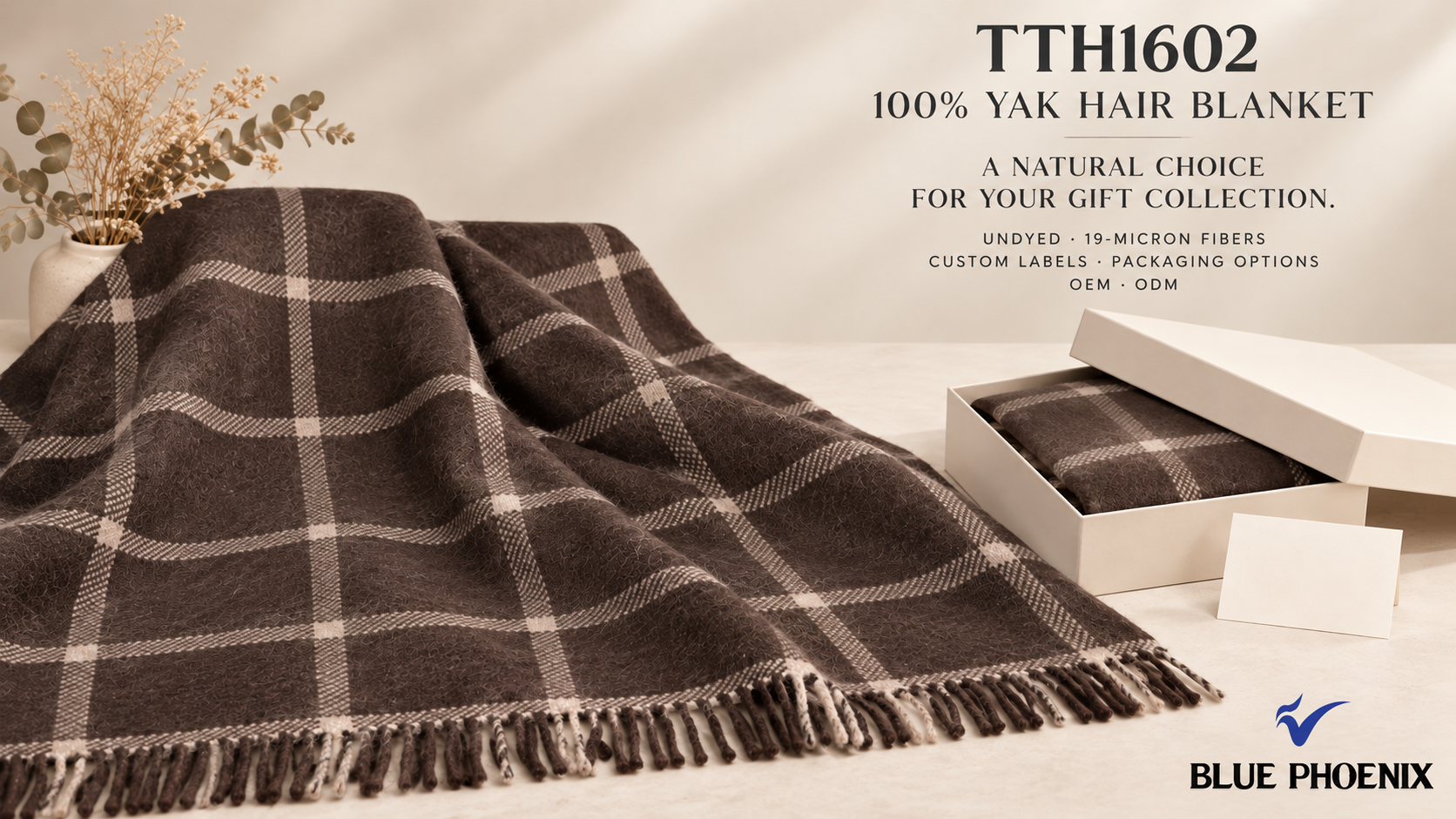
TTH1602 Undyed Yak Hair Windowpane Throw
A woven 100% yak hair throw with a brown and grey-beige windowpane design and twisted fringed ends.
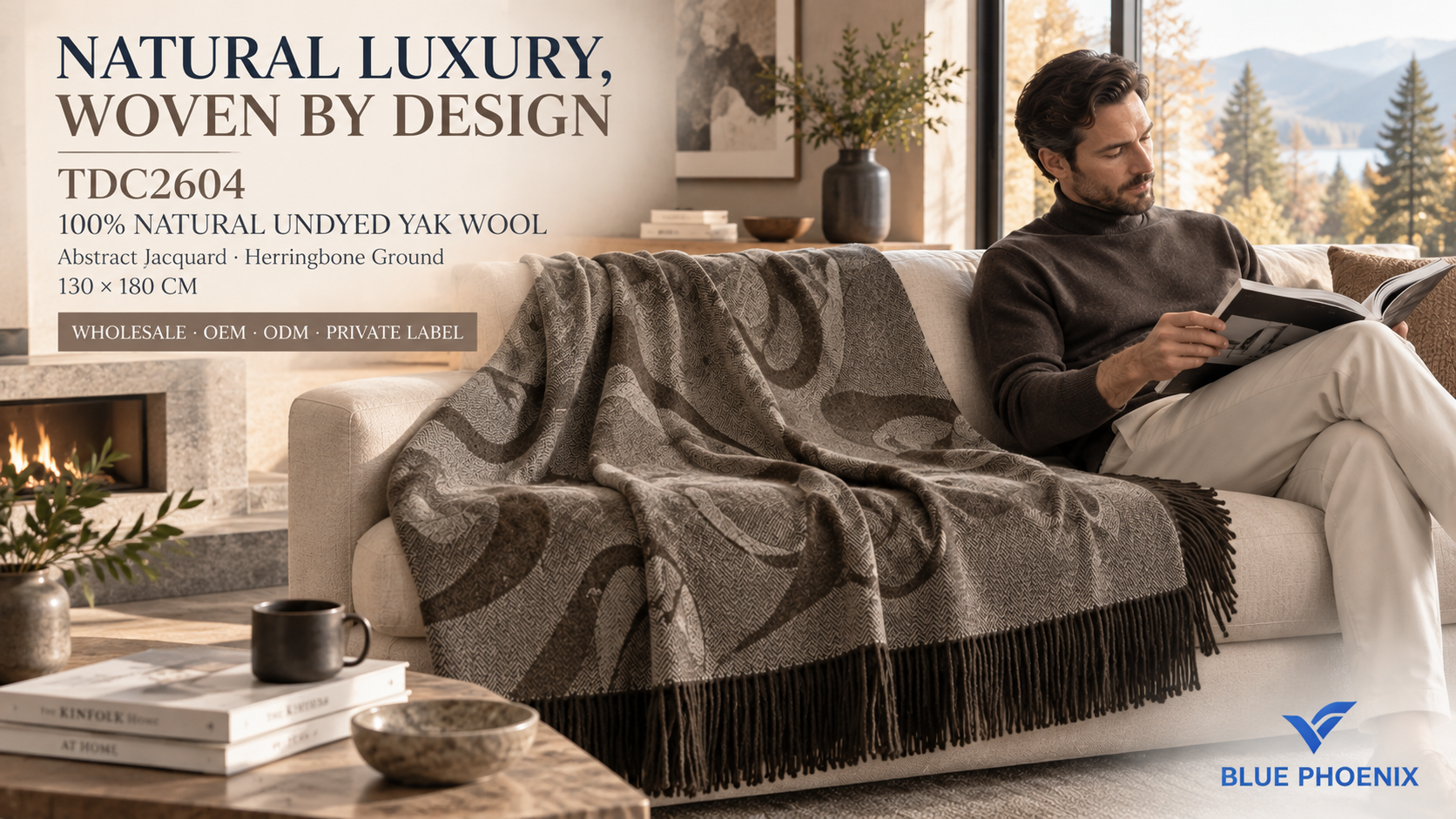
TDC2604 Undyed Yak Wool Jacquard Throw
Natural black and grey yak wool creates an abstract flowing-curve jacquard design with fringed ends.
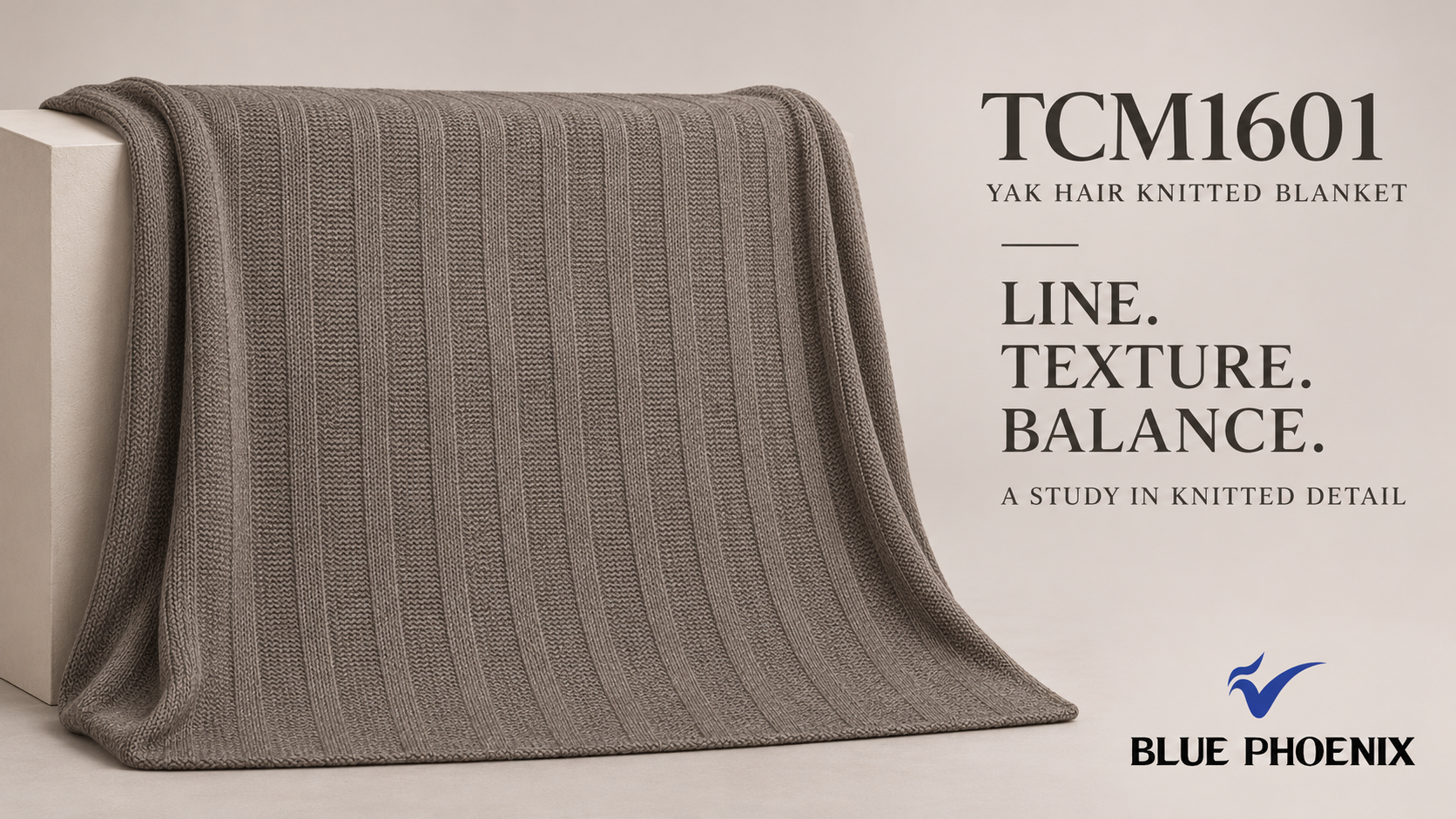
TCM1601 Yak Fiber Ribbed Knit Blanket
A brown yak-fiber blanket with a defined ribbed knitted surface for textured home and retail collections.
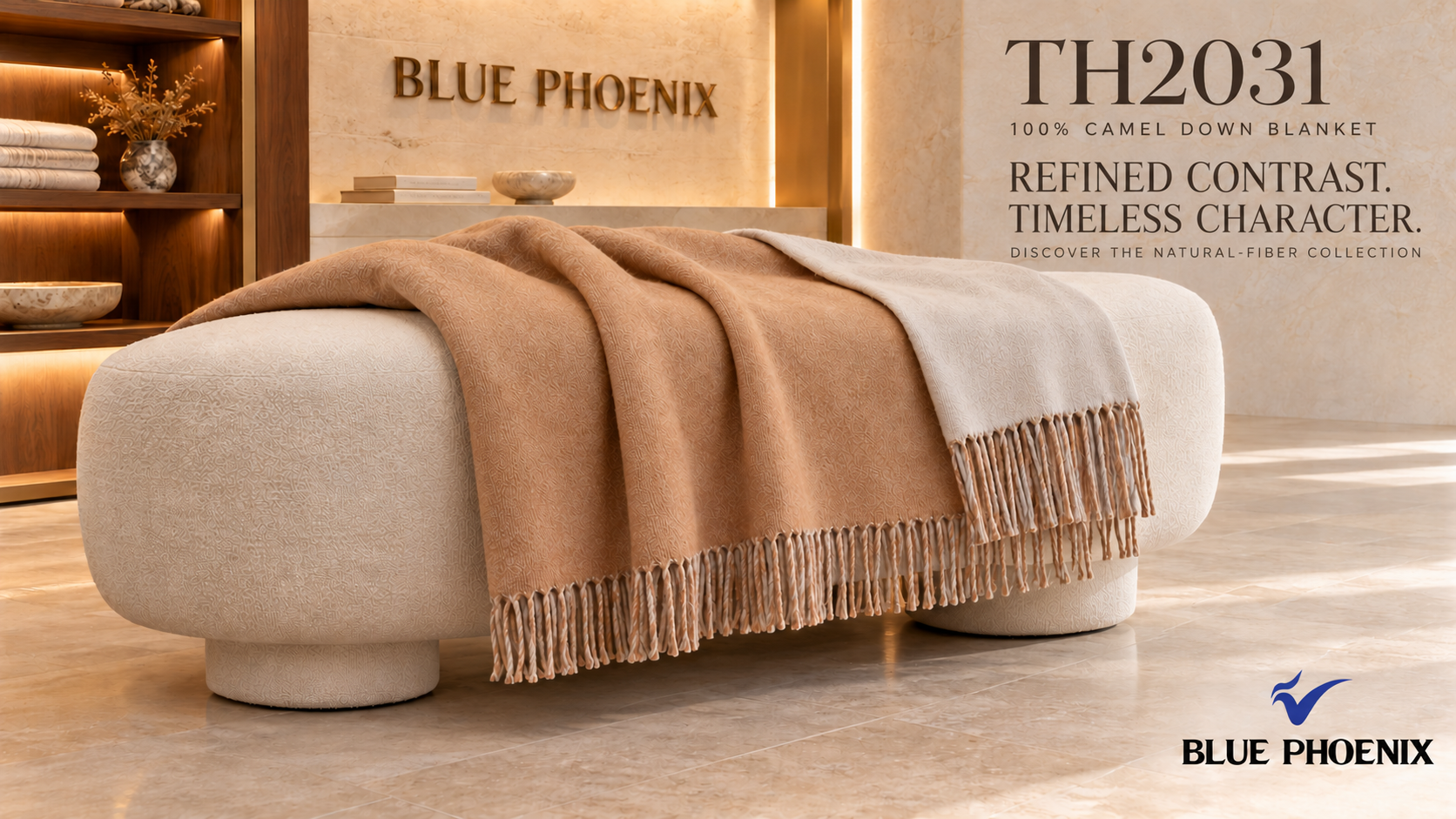
TH2031 Camel Down Throw Blanket
A camel and raw-white reversible throw with fringed ends, offering another natural-fiber direction for premium collections.
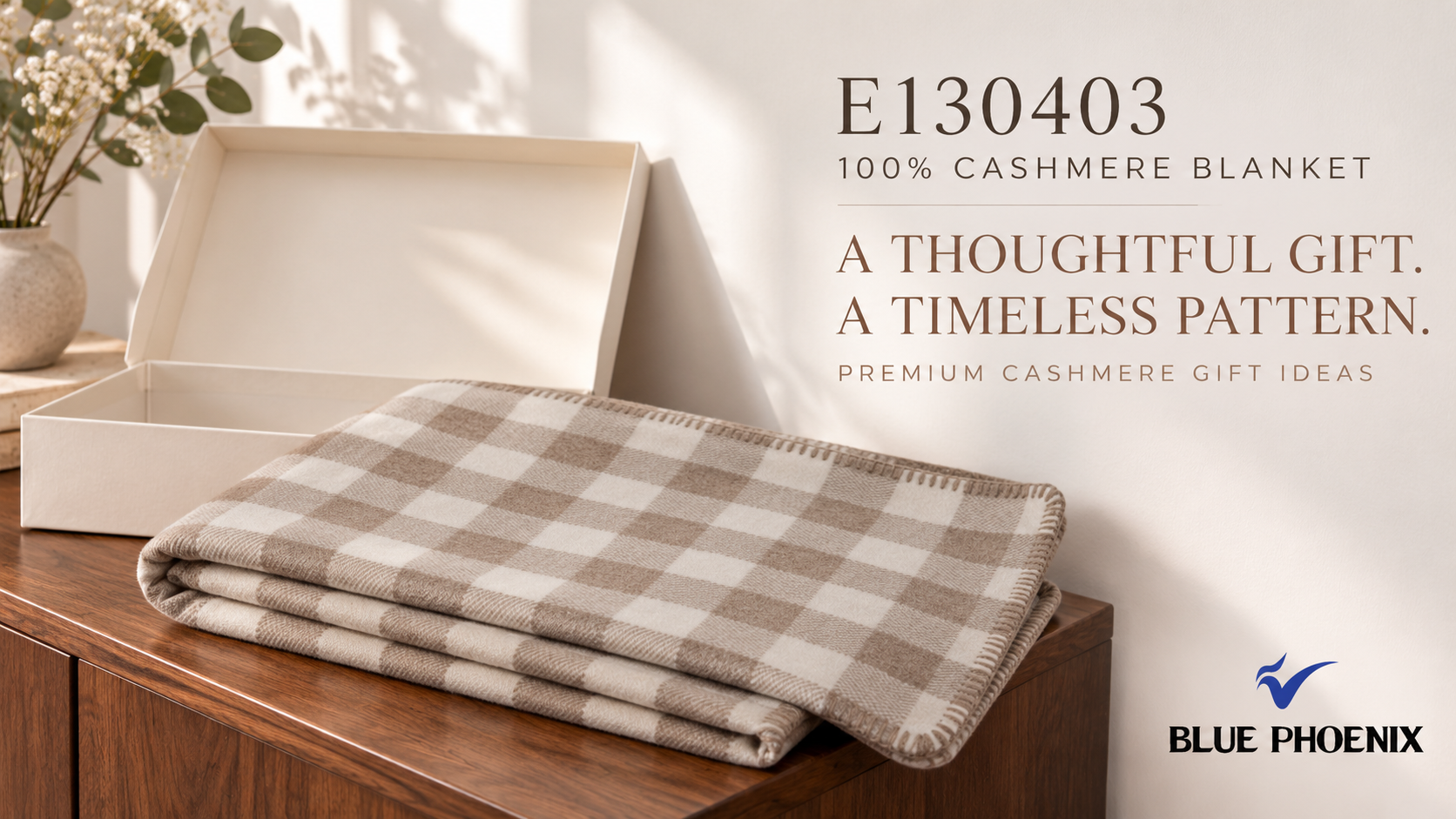
E130403 Natural Undyed Cashmere Throw
An ivory and taupe cashmere throw with a checkerboard design, coordinated edge stitching and rounded corners.
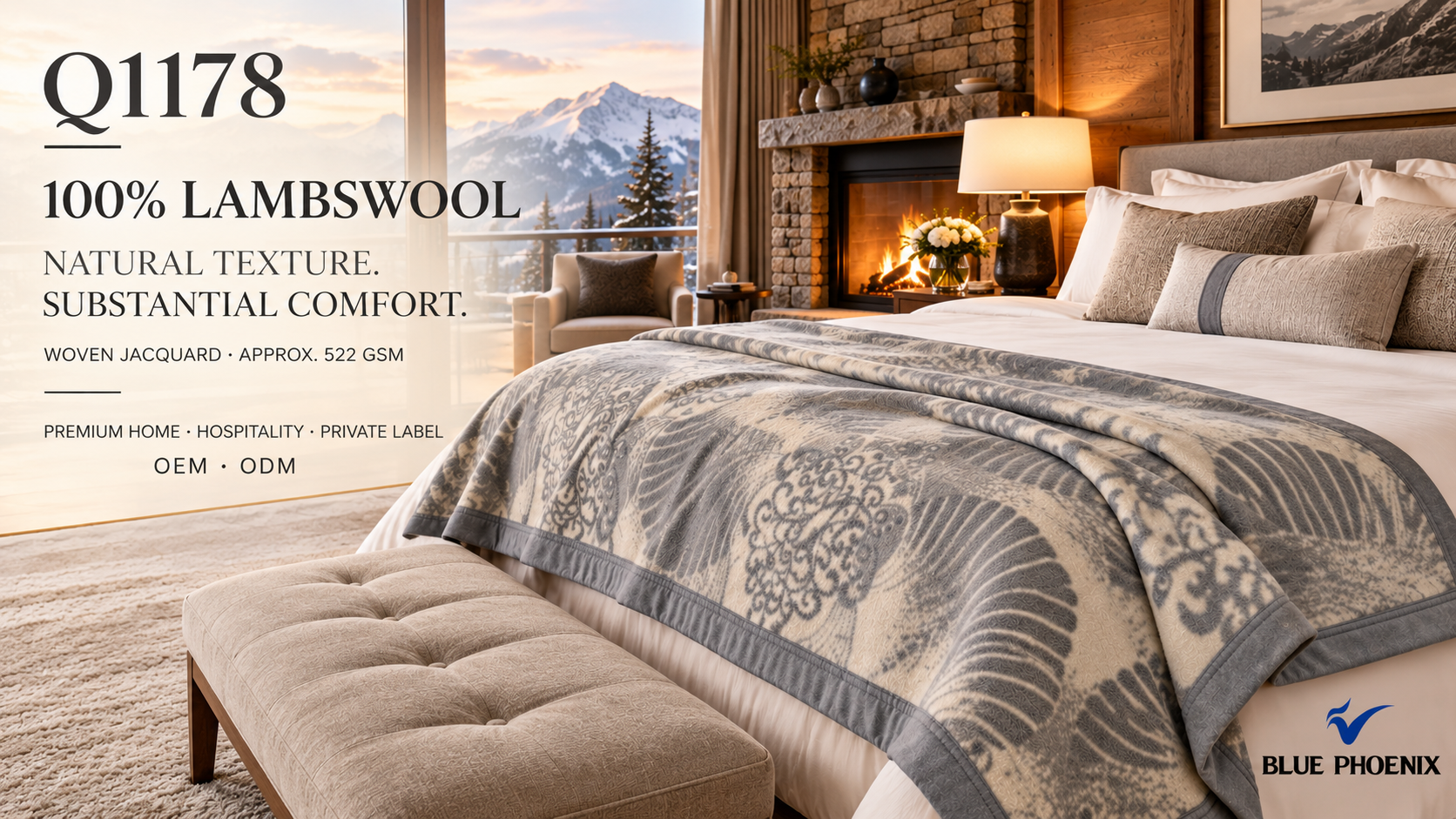
Q1178 Lambswool Jacquard Bed Blanket
A grey and ivory lambswool bed blanket with a woven decorative pattern and coordinated four-sided binding.
.
Yak have coarser outer hair and a finer undercoat commonly described as down. Fiber selection and processing affect the material supplied for textile production. Ask for the actual composition and relevant fiber details rather than assuming every yak blanket uses the same material.
There is no universal ranking. Fiber characteristics, coarse-hair content, yarn structure, construction and finishing all affect the handle. Compare finished samples under similar conditions, checking both faces, the edges and the overall drape.
Only if the care instructions for that specific finished product permit it. Confirm the approved cleaning and drying process before washing. Composition alone does not establish machine-wash suitability.
No. Undyed describes the absence of a dyeing process for the stated material or color effect. An organic claim requires its own applicable supporting documentation. Undyed also does not mean that a blanket has undergone no cleaning, processing or finishing.
They may be considered for guestroom accents, suites or lounge areas. Suitability depends on the product, housekeeping process, care requirements and the hotel’s purchasing criteria. Trial the intended use and cleaning process before approving a hospitality order.
Provide the intended market, application, quantity, target dimensions, construction, color direction, label and packaging requirements, care expectations and delivery destination. Include any required testing or documentation so these requirements can be reviewed during development.
What is a yak blanket?
A blanket made with yak fiber, either as the stated sole body material or as part of a declared blend.
Is yak down bird down?
No. In this context, down refers to the finer undercoat of the yak.
Are all yak blankets equally soft?
No. Fiber selection, processing, yarn structure and finished construction influence the surface feel.
What should a composition statement explain?
It should identify the declared fiber content, with separate clarification for bindings or other trims where relevant.
Can yak blankets have natural colors?
Yes. Some products use undyed fiber colors. Confirm the specification of the particular blanket.
Does a brown blanket have to be undyed?
No. Color appearance alone does not establish whether dyeing was used.
Does undyed mean chemical-free?
No. It does not describe every cleaning, processing or finishing step.
Is a heavier yak blanket always warmer?
No. Dimensions, thickness, construction, coverage and use conditions also affect the comparison.
Does piece weight mean GSM?
No. Piece weight is the total weight of a blanket. GSM describes weight per square meter.
Should fringe be included in blanket dimensions?
The measurement basis should be stated clearly. Separating body dimensions and fringe length helps buyers compare products.
Can yak blankets be woven?
Yes. Woven constructions can include plain, checked and jacquard designs.
Can yak blankets be knitted?
Yes. Knitted constructions offer a different surface structure and should be assessed for stretch, recovery and shape retention.
Can a home yak throw be assigned a temperature rating?
A temperature rating should not be stated without appropriate evidence for the specific finished product.
Are yak blankets guaranteed not to pill?
No. Pilling behavior depends on the finished product, friction and use conditions.
What is the difference between pilling and shedding?
Pilling forms small entangled fiber balls on the surface. Shedding releases fibers from the textile.
Can a yak blanket be used as a sofa throw?
Yes, when its dimensions, handle, construction and care requirements suit that application.
Is every yak throw large enough for a bed?
No. Compare actual dimensions with the mattress size and required overhang.
What should retailers check before ordering?
Composition, sample quality, dimensions, weight, finishing, care instructions, labels, packaging and order terms.
Can a brand request custom packaging?
Packaging and labeling requirements can be reviewed during project development, subject to approval and order conditions.
How can buyers discuss a BLUE PHOENIX project?
Send the product brief by email or WhatsApp, including quantity, intended market, application and delivery destination.
#YakBlanket #YakWoolBlanket #YakDownBlanket #YakHairBlanket #UndyedYakBlanket #NaturalFiberBlanket #WovenYakBlanket #KnittedYakBlanket #PrivateLabelBlankets #WholesaleBlankets
Continue comparing natural-fiber blankets through dimensions, construction, finishing and sample evaluation. This guide explains how to review size, weight, weave and care when selecting a cashmere blanket.
Read the Cashmere Blanket Buying Guide →
Review surface feel, maintenance, weight and purchasing considerations when comparing wool blankets with other natural-fiber options. Use the intended application and actual sample as the basis of your selection.
Read the Wool Blanket Buying Considerations →
Explore yak-fiber blankets and compare woven, patterned and knitted options. Review each product’s composition, construction, finishing and care requirements for your intended collection.
Discover cashmere throws and blankets for premium home, gifting and retail collections. Compare actual samples for handle, drape, surface detail and edge finishing.
Consider camel-fiber blankets as another material direction for a natural-fiber assortment. Assess the stated composition, color, dimensions and finishing against the requirements of your project.
Compare wool constructions, patterns and finishing options for throws and bedding collections. Select the size, weight and care requirements appropriate to the intended use.
Explore three yak-fiber constructions alongside camel down, cashmere and lambswool alternatives. Compare each product’s composition, surface, finishing and intended use when developing your collection.
TTH1602 is a woven 100% yak hair blanket featuring a deep brown ground, grey-beige windowpane lines and twisted fringed ends. Its restrained natural-color design suits sofa styling, reading chairs, decorative bed layering and premium gifting.
Review the original woven surface, check alignment, drape and fringe when assessing the sample. This design provides a traditional patterned option within a natural-fiber assortment.
Explore the TTH1602 Undyed Yak Hair Blanket →
TDC2604 combines 100% yak wool with natural black and grey colors. Its abstract flowing-curve jacquard design, subtle herringbone ground and fringed ends offer a contemporary alternative to traditional checks.
Consider this woven throw for premium retail, interior styling, gifting and private-label home-textile collections. Inspect the jacquard definition, surface consistency and fringe against the approved sample.
Explore the TDC2604 Yak Wool Jacquard Throw →
TCM1601 offers a brown yak-fiber knitted blanket with a defined ribbed surface. It provides a different construction to compare with woven yak throws when planning a textured home collection.
During sample approval, assess the knitted texture, drape, stretch, recovery and finished edges. Confirm the final dimensions, piece weight and care instructions in the order specification.
Explore the TCM1601 Ribbed Knit Yak Blanket →
TH2031 is a 100% camel down throw with a camel-colored face, raw-white reverse and twisted fringed ends. Its reversible presentation offers another natural-fiber direction for coordinated home collections.
Compare its handle, drape and finishing with the yak-fiber samples when selecting products for sofa, bedroom or gifting assortments. Confirm the required dimensions and presentation details during sample approval.
Explore the TH2031 Camel Down Throw →
E130403 is a 100% cashmere throw featuring an ivory and taupe checkerboard design, coordinated taupe edge stitching and rounded corners. Its pattern and neatly finished edges provide a different visual option from fringed yak blankets.
Consider it for premium home, boutique retail and private-label gifting collections. Assess the actual sample for surface feel, drape, pattern definition and edge consistency.
Explore the E130403 Natural Undyed Cashmere Throw →
Q1178 is a 100% lambswool bed blanket with a grey-and-ivory woven jacquard design and coordinated four-sided grey binding. Its substantial bed-blanket format gives buyers a useful comparison with smaller decorative throws.
Evaluate coverage, handling, edge finishing and the proposed care process for bedding, hospitality or premium residential collections. Match the actual dimensions to the target bed and required overhang.
Explore the Q1178 Lambswool Jacquard Bed Blanket →
The following reference provides background on yak outer hair and fine down. General fiber information does not establish the performance of an individual finished blanket.
FAO: Fibre Production and Hides →
Planning a wholesale yak blanket order or a private-label natural-fiber collection? Share your intended application, quantity, target dimensions, construction, design direction, labels, packaging and delivery destination.
BLUE PHOENIX can review the brief and discuss suitable samples, development requirements and quotation options. Include any specific care expectations, testing requirements or documentation needed for your target market.
Confirm the final specification and approved sample before bulk production. A clear approval process helps align composition, color, construction, finishing and brand presentation with your collection requirements.
Website:www.shbluephoenix.com
Email:jamesli@shrainbow.cn
WhatsApp:+86 18017830390
WeChat: bluephoenix66

Blue Phoenix Blankets dedicated to strict quality control of blankets and scarves products and thoughtful customer service, our custom blankets wholesale products are exported to clients in such countries and regions as United states, Europe, Australia, Russia, Germany, Japan.
Copyright © 2026 Shanghai Rainbow Enterprise Development Co., Ltd. - All Rights Reserved.