High-Quality Wholesale Blankets Manufacturer & Supplier in China with custom design service - Blue Phoenix Blankets
Language
A successful airline blanket order begins with a clearly defined sample. Colour and initial hand feel matter, but buyers also need to review coverage, finished weight, fabric consistency, border artwork, edge construction, care requirements and packaging.
BLUE PHOENIX TDT2003 provides a reference for this process: a 100% modacrylic airline blanket with a red woven body, contrasting grey-beige jacquard border bands, rounded corners and narrow overlock stitching. Its reference dimensions are 106 × 157 cm, with an approximate weight of 322 g per piece.
This guide explains how airline procurement teams, inflight textile distributors and private-label buyers can assess the sample and prepare a consistent specification for bulk production.
1. Define the Intended Blanket ProgrammeBefore comparing quotations, explain where and how the blanket will be used. An aircraft passenger-comfort programme, an airport lounge collection and a retail travel assortment may require different dimensions, care arrangements and packaging.
Describe the intended coverage, storage method and distribution process. Explain whether the blanket will enter a repeated laundering programme, and provide any operator-specific technical requirements.
For an aircraft cabin project, consider how the blanket will be folded, presented, distributed and collected. For a lounge or travel collection, review the product against the intended seating and service arrangements.
A clear application brief helps suppliers quote against the same requirements. Without it, similar-looking quotations may represent different materials, dimensions, finishing or packing methods.
2. Record the TDT2003 Reference SpecificationThese figures describe the reference product. Custom dimensions, weight, colour and border artwork require development review and sample approval.
Agree on measurement methods and production tolerances before confirming the order. Keep the approved specification together with the physical sample so that both provide a consistent production reference.
3. Measure Coverage and Finished WeightOpen the sample fully and measure it using an agreed method without stretching the fabric. Record the length and width separately, then review coverage against the intended seat or user area.
Check the blanket in a natural drape as well as a flat position. This helps buyers assess how the fabric hangs, where its edges fall and how the border bands appear during use.
Piece weight and GSM are different measurements. The approximately 322 g figure refers to one finished blanket. It should not be entered into the specification as 322 GSM.
When comparing samples, confirm whether the recorded weight includes labels or packaging. Use the same measurement basis when inspecting production.
Also examine the folded sample. Meeting the flat dimensions does not automatically establish whether the blanket fits the proposed individual packaging or service-storage arrangement.
4. Inspect the Woven Body and Both SurfacesReview the red woven field under consistent lighting. Look for visible irregularities, broken yarns, marks and inconsistent areas. Compare the sample with the approved colour and construction references.
Inspect both the face and reverse. Turning a corner reveals how the jacquard border appears on the opposite surface and how the fabric behaves when folded.
Assess hand feel alongside drape, thickness and fabric consistency. Initial softness is useful during sample selection, but it does not establish laundering performance or service life.
If surface appearance or pilling resistance matters to the programme, define the required evaluation and acceptance criteria before production.
Photographs support the review, but the approved physical sample should establish the reference for colour, handle and workmanship.
5. Approve Jacquard Border Artwork CarefullyThe contrasting border bands are an important part of TDT2003’s appearance. For a custom airline blanket, review their width, position, colour, artwork scale and relationship to the blanket edges.
Provide authorised artwork with clear dimensions. Discuss whether fine details and lettering can be reproduced at the proposed woven scale.
A digital layout helps communicate the design, but the woven sample should establish the approved textile appearance. Review artwork on both surfaces where the reverse will be visible.
Existing customer names and emblems are not included as standard branding. New orders should use the buyer’s authorised design or an agreed unbranded version.
Retain the approved artwork version with the sample and written specification. Any later change to the wording, emblem, placement or border arrangement should be recorded and approved.
6. Check Rounded Corners and Overlock StitchingTDT2003 uses narrow overlock stitching and rounded corners. These details should form part of the purchasing specification.
Inspect the perimeter for stitch continuity, loose threads, skipped stitches and uneven transitions. Compare the corner shapes and check that the stitching follows the approved outline.
Review the edges with the blanket laid flat and folded. Check whether the finishing lies naturally and whether any areas differ noticeably from the approved reference.
TDT2003 has no fringe, tassels or satin binding. A change to the edge construction requires separate development and approval because it changes the finished product.
7. Review Care Requirements and Supporting DocumentationFor a reusable blanket programme, provide the intended washing, drying and handling process during development. Care instructions should relate to the approved finished product.
Where laundering trials are required, agree on the procedure and review criteria. These may include:
Dimensional change after the specified care process.
Colour change and colour transfer.
Surface appearance and pilling.
Overlock stitching and corner condition.
Label attachment and legibility.
Modacrylic composition alone does not establish approval for a specific airline programme. Provide the required flammability or other performance test methods, acceptance criteria and documentation requirements before ordering.
Review whether supporting reports cover the relevant product specification and conditions. General descriptions such as “non-flammable” or “approved for all aircraft” should not replace this assessment.
Agree on testing responsibilities, costs and timing before confirming the production schedule.
8. Coordinate Labels, Folding and PackagingApprove label information before production. Confirm the composition wording, care information, attachment position and any required buyer identification.
For a private-label airline blanket, check whether the label remains visible after folding and whether its position suits the intended presentation.
Review packaging with the blanket inside it. Confirm:
The folding method and finished packed dimensions.
Individual packing materials.
Printed artwork and product information.
Quantity per export carton.
Carton dimensions, gross weight and markings.
Freight planning should use confirmed packing information rather than estimates based only on blanket weight.
Keep an approved packed sample as part of the order reference. This connects the textile specification with the presentation the buyer receives.
9. Prepare the Custom-Order BriefA complete enquiry helps BLUE PHOENIX review the project and prepare an appropriate quotation.
Include the following information:
The minimum order quantity is 3,000 pieces. Orders involving several colours, artwork versions or packing formats require a quantity breakdown for review.
Sample and courier charges apply. Standard payment terms are 30% deposit and 70% balance before shipment. Current pricing and production timing are confirmed against the final specification, approved sample and order requirements.
ConclusionTDT2003 sample approval should connect the blanket’s appearance with a complete purchasing specification. Review the 100% modacrylic composition, 106 × 157 cm dimensions, approximately 322 g piece weight, jacquard border layout, rounded corners and overlock finishing.
Then confirm the care process, required documentation, labels, folding, packaging and commercial terms. An approved sample and clear written specification give buyers and suppliers a consistent reference for bulk production.
Contact BLUE PHOENIX to discuss a TDT2003 sample and a custom airline blanket order from 3,000 pieces.
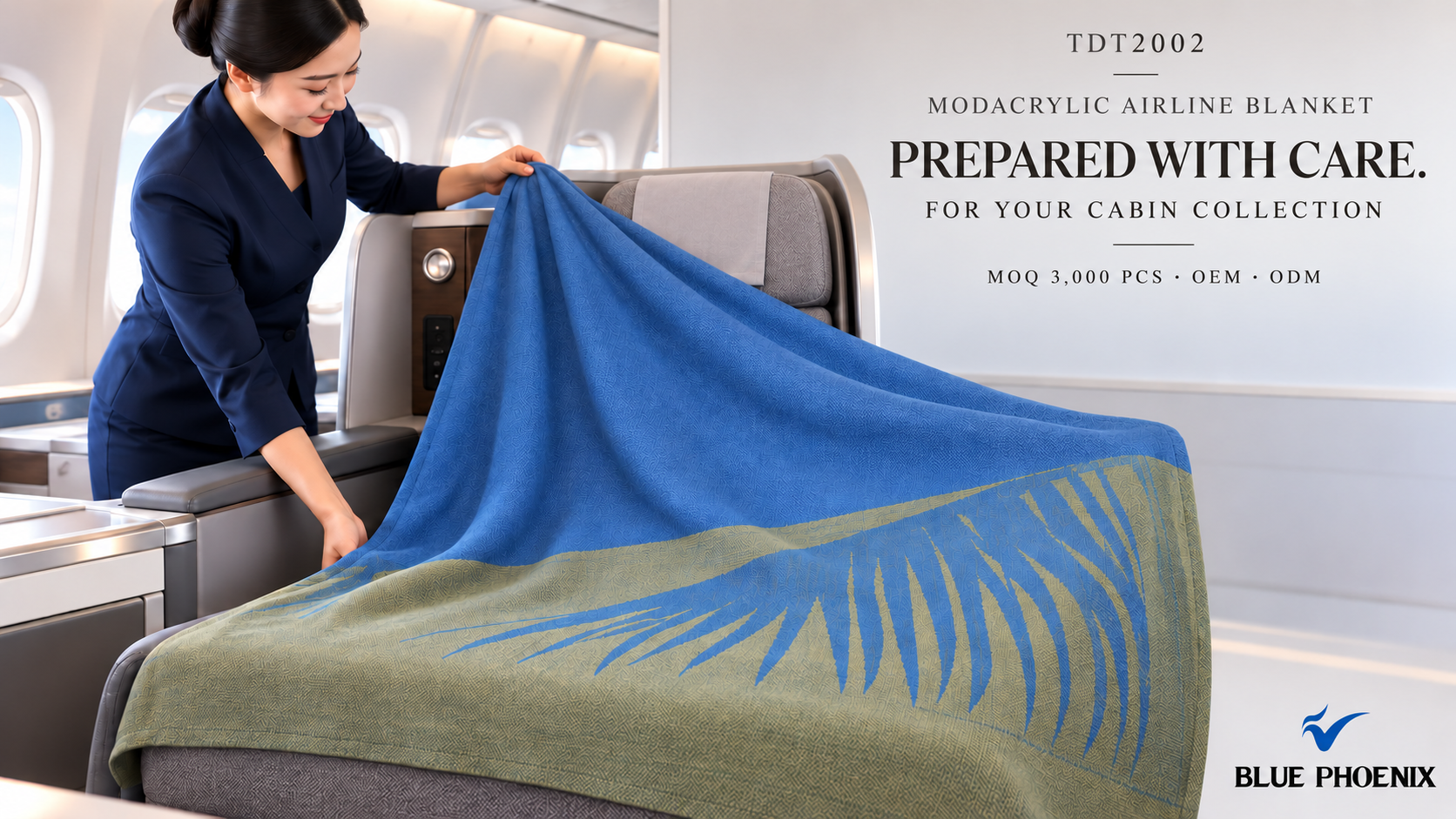
TDT2002 Modacrylic Airline Blanket
Compare a blue woven design with contrasting jacquard detailing for airline textile development.
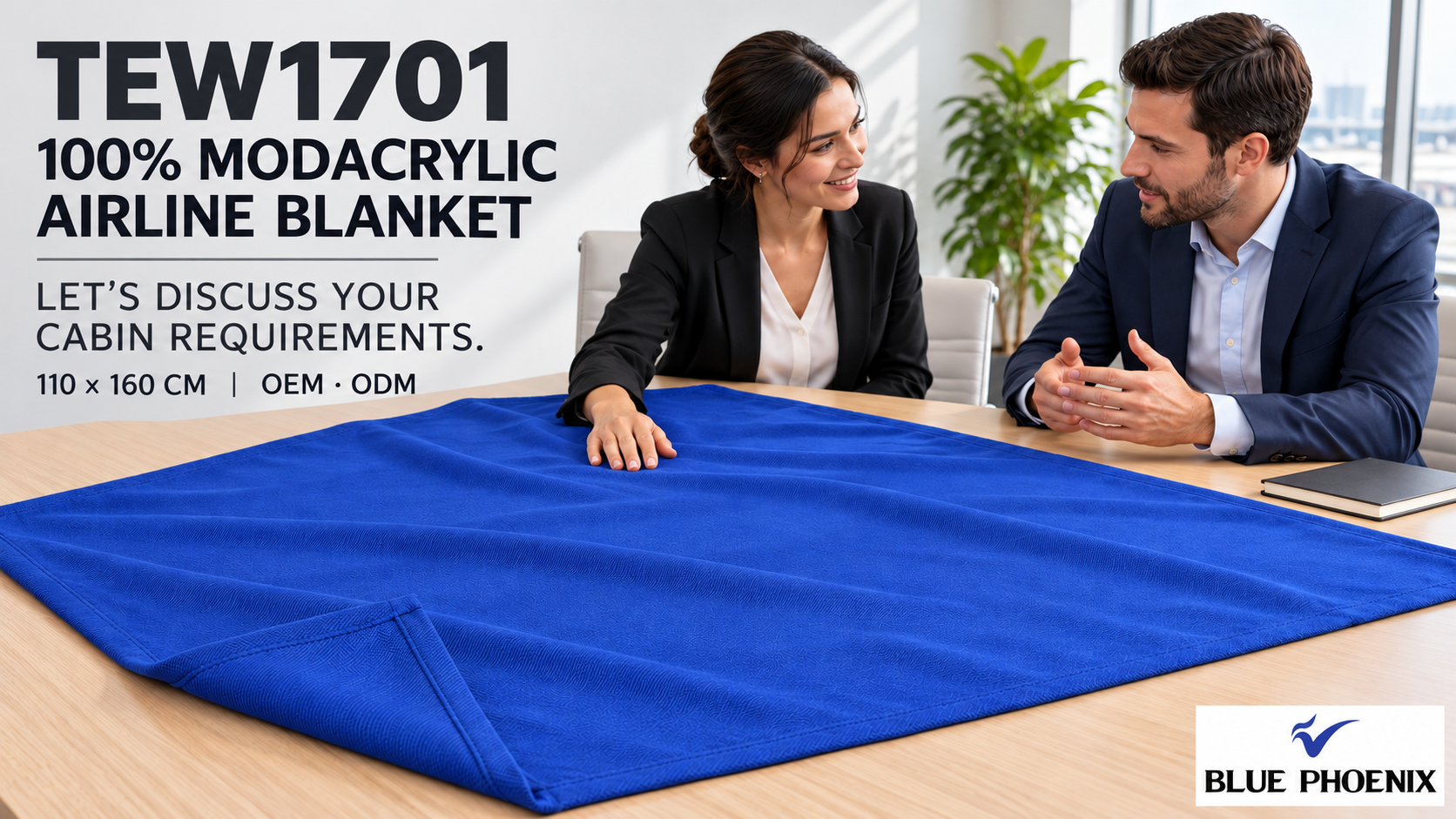
TEW1701 Royal-Blue Airline Blanket
Review a plain modacrylic blanket with fine twill texture and matching stitched hems.
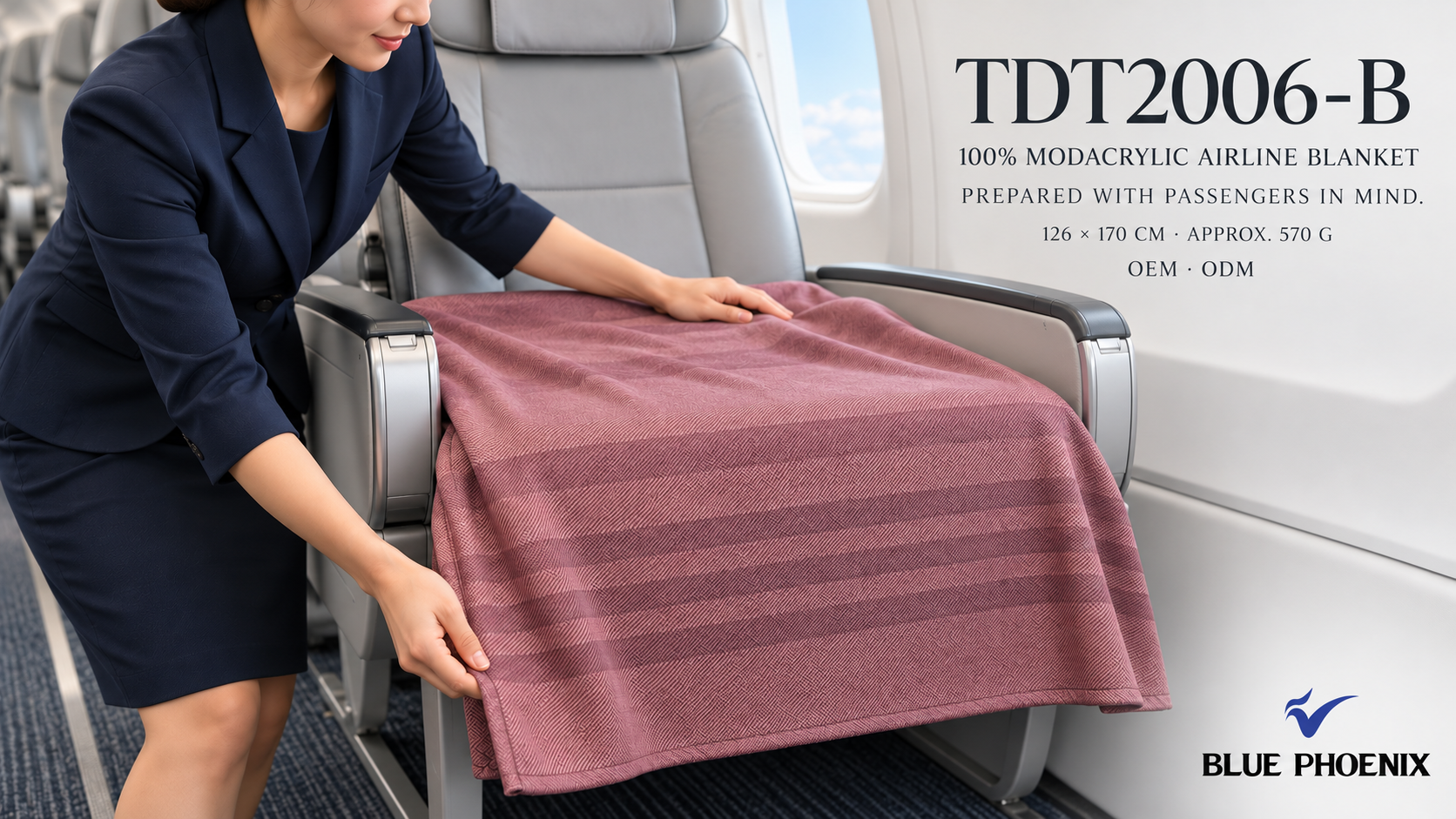
TDT2006-B Modacrylic Airline Blanket
Explore another woven colour and border direction for a coordinated airline blanket collection.
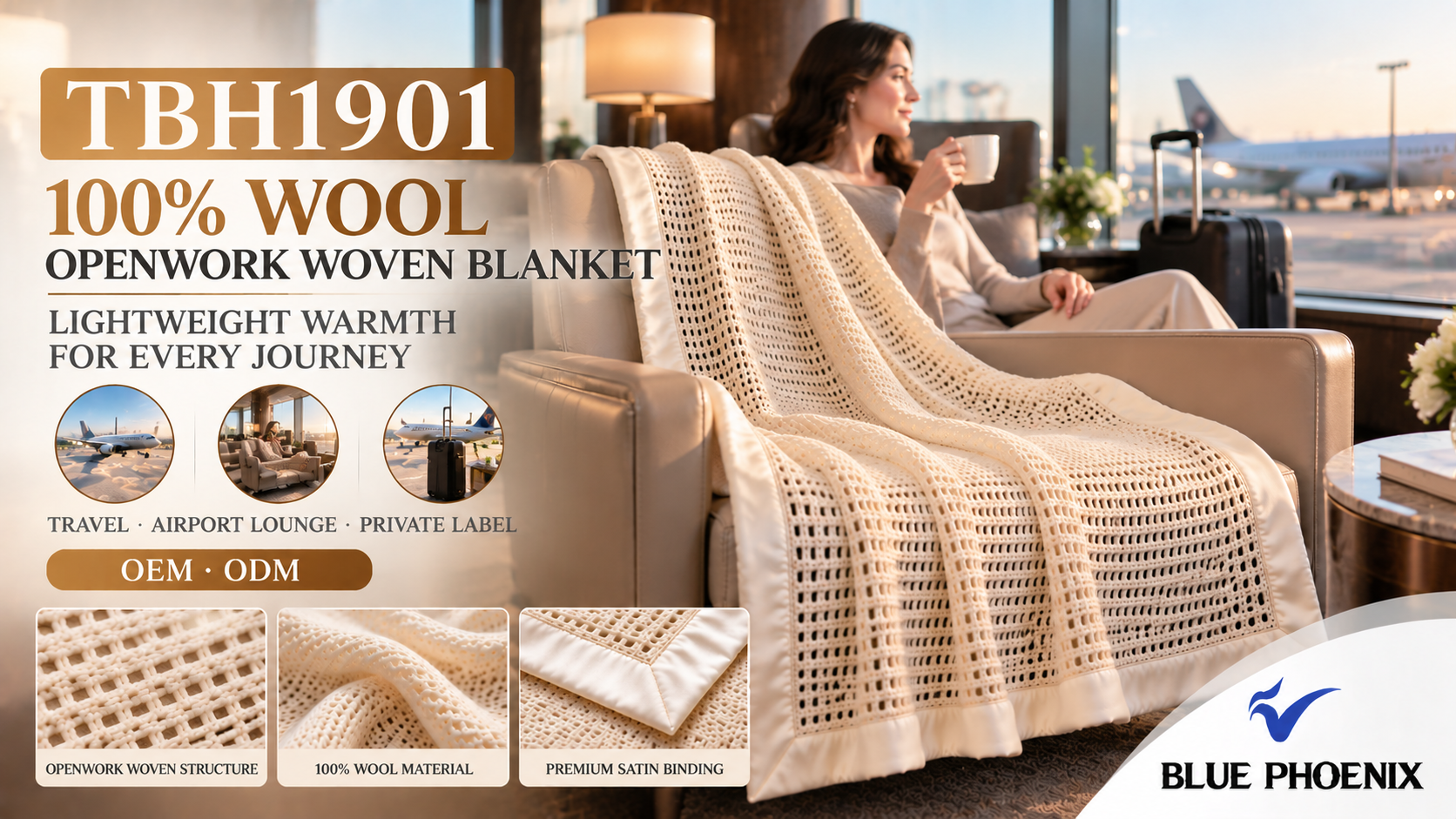
TBH1901 Openwork Wool Blanket
An ivory wool blanket with satin binding for separate lounge and hospitality textile briefs.
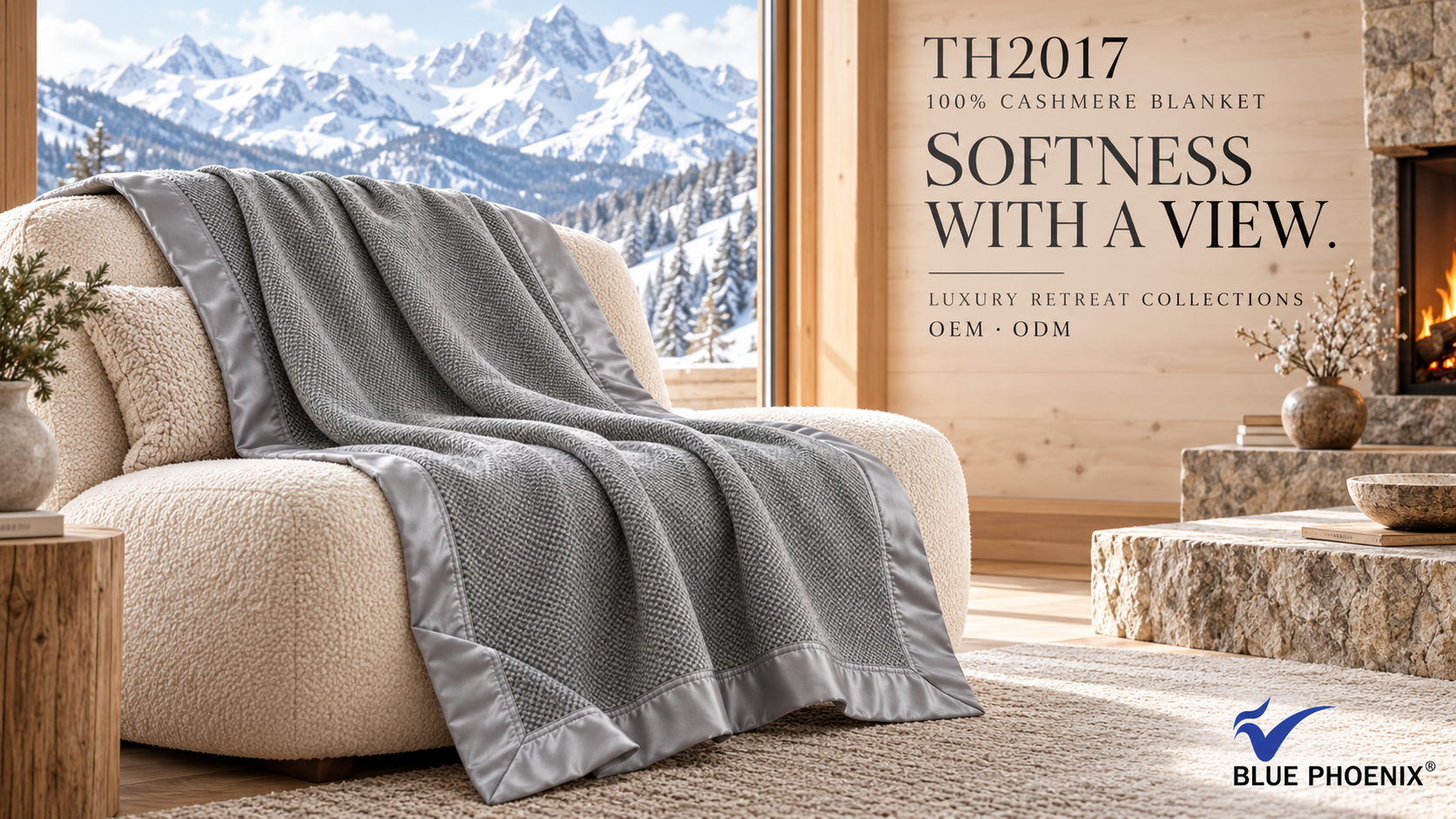
TH2017 Cashmere Blanket
A cashmere blanket with silk satin edging for premium hospitality and private-label collections.
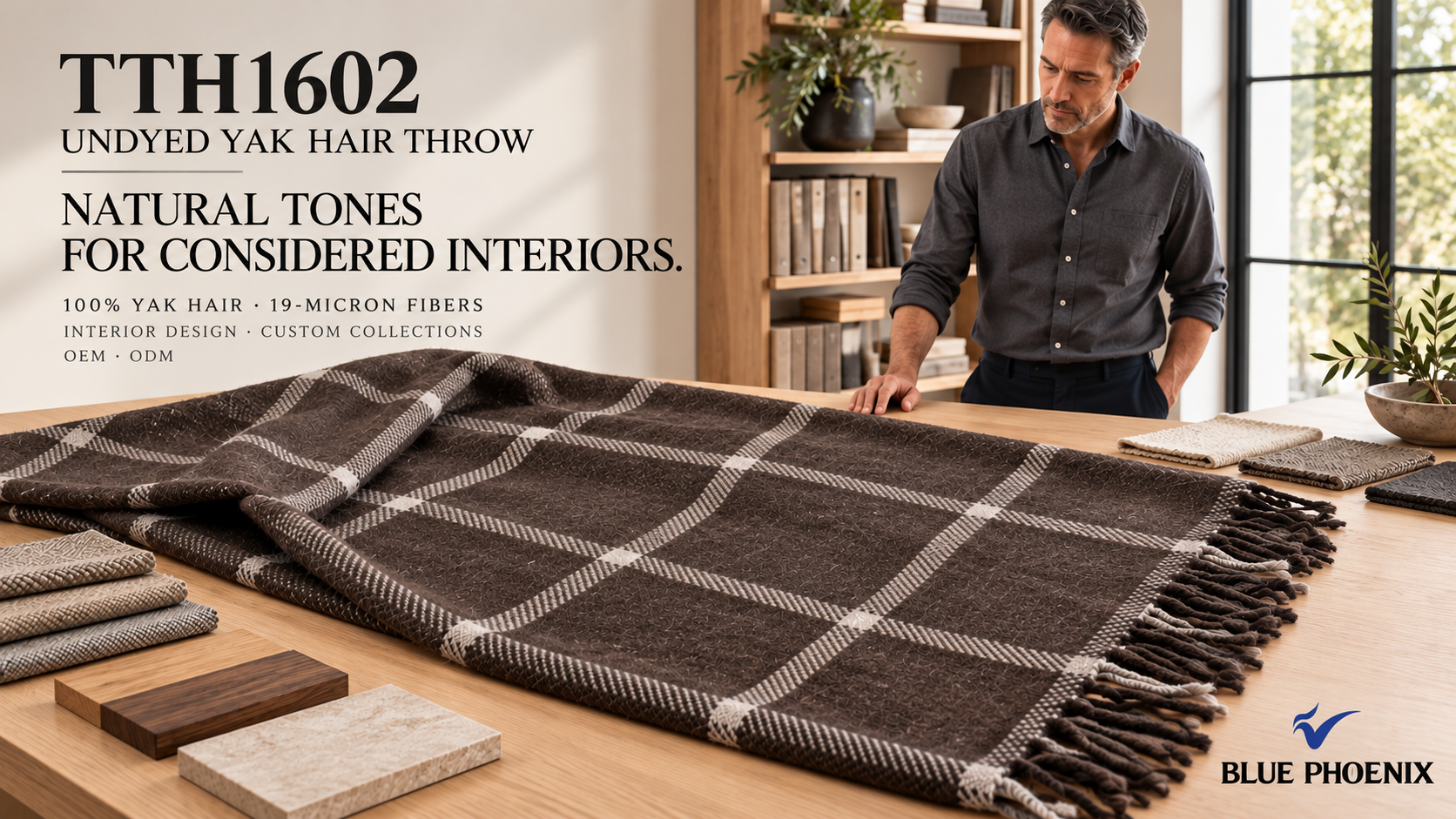
TTH1602 Undyed Yak Hair Blanket
A natural-colour windowpane throw for premium retail, gifting and interior textile collections.
Confirm the model, composition, dimensions and piece weight. Then inspect the woven body, border layout, rounded corners and overlock stitching against the purchasing brief.
Custom woven artwork can be reviewed. Provide authorised files, proposed dimensions and placement. Feasibility and the final appearance are confirmed through sampling.
No. Approximately 322 g is the reference weight of one finished blanket. GSM describes fabric mass per square meter and should be recorded separately when required.
No. Buyers should specify the required test methods, acceptance criteria and documentation. Review their applicability to the relevant finished product before confirming approval claims.
The MOQ is 3,000 pieces. Provide a quantity breakdown when requesting multiple colours, artwork versions or packing formats.
Approve the reference sample, written specification, colour, artwork, labels, care requirements, packing and any required evaluation. Confirm commercial terms and timing separately.
What is the reference model?
TDT2003.
What is the composition?
100% modacrylic.
What are the reference dimensions?
106 × 157 cm.
What is the reference piece weight?
Approximately 322 g.
What is the main colour?
Red with contrasting grey-beige border bands.
Is the border woven?
Yes. The reference design uses jacquard border detailing.
Does the blanket have fringe?
No.
How are the edges finished?
With narrow overlock stitching and rounded corners.
Should both surfaces be inspected?
Yes. Review the face and reverse for appearance and consistency.
Can a screen image establish the final colour?
No. Use an approved physical reference for production colour approval.
Can custom dimensions be requested?
Yes, subject to development review and sample approval.
Can a buyer use its own artwork?
Authorised artwork can be submitted for feasibility review.
Are existing airline names included?
No. New versions use buyer-approved artwork or an agreed unbranded design.
Are samples chargeable?
Yes. Sample and courier charges apply.
Can a fixed wash-cycle lifespan be assumed?
No. Any such claim needs an agreed evaluation for the relevant finished product.
What should a care brief include?
The proposed washing, drying and handling process, with required acceptance criteria.
Why approve a packed sample?
It confirms folding, labels, individual packaging and presentation together.
What information is needed for freight planning?
Confirmed carton quantities, dimensions, gross weights and destination details.
What are the standard payment terms?
30% deposit and 70% balance before shipment.
What starts a quotation discussion?
A clear specification, quantity breakdown, artwork, packing brief, testing requirements and destination.
Airline Blanket Materials: A TDT2003 Modacrylic Buyer’s Guide — review the material-selection side of the purchasing decision.
Custom Airline Blankets: An OEM Guide to Jacquard and Labels — prepare artwork, labels and presentation requirements.
TDT2003 100% Modacrylic Red Airline Blanket
Review the product reference, composition, dimensions, finishing and bulk-order information before requesting a sample.
Compare airline textile references first, then review separate natural-fibre options for lounge, hospitality and premium collections. Products below are not presented as equivalent aviation-approved substitutes.
TDT2002 Modacrylic Airline Blanket — blue woven design with contrasting jacquard detailing.
TEW1701 Royal-Blue Airline Blanket — plain woven design with matching stitched hems.
TDT2006-B Modacrylic Airline Blanket — an alternative woven colour and border direction.
TBH1901 Openwork Wool Blanket — ivory wool with satin binding for separate hospitality briefs.
TH2017 Cashmere Blanket — a premium collection option with silk satin edging.
TTH1602 Undyed Yak Hair Blanket — a natural-colour windowpane throw.
Tags: #TDT2003 #AirlineBlanket #ModacrylicBlanket #RedAirlineBlanket #SampleInspection #CustomAirlineBlankets #JacquardBlanket #PrivateLabelBlankets #WholesaleBlankets #AirlineProcurement
BLUE PHOENIX supports OEM, ODM and private-label blanket projects. Send your required quantity, dimensions, target weight, colour reference, woven artwork, labels, packaging, testing requirements and delivery destination.
MOQ: 3,000 pieces. Samples: Sample and courier charges apply. Current pricing and production timing are confirmed after reviewing the final brief.
Website: www.shbluephoenix.com
Email: jamesli@shrainbow.cn
WhatsApp: +86 18017830390
WeChat: bluephoenix66

Blue Phoenix Blankets dedicated to strict quality control of blankets and scarves products and thoughtful customer service, our custom blankets wholesale products are exported to clients in such countries and regions as United states, Europe, Australia, Russia, Germany, Japan.
Copyright © 2026 Shanghai Rainbow Enterprise Development Co., Ltd. - All Rights Reserved.