Blog Posts
High-Quality Wholesale Blankets Manufacturer & Supplier in China with custom design service - Blue Phoenix Blankets
Language
A private-label wool scarf order starts with a clear product specification. Photographs help communicate appearance, but buyers also need agreed requirements for material, dimensions, design, finishing, labels and packaging.
BLUE PHOENIX TH2116 provides a practical example. The supplied sample tag specifies 100% wool, a 58 × 193 cm body, an additional 2 cm fringe at each short end and a reference weight of 255 g.
Its peach-pink fabric features small round perforations arranged in staggered rows. This design makes physical sample approval particularly useful: opening size, spacing, fabric condition and finishing all contribute to the final presentation.
1. Define the Reference ProductStart by separating the standard sample from any requested changes.
For TH2116, the reference includes its wool composition, rectangular dimensions, short fringe, piece weight and perforated appearance. The product photographs also provide a reference for the peach-pink color and brushed surface.
A different shade, revised size, alternative hole arrangement or branded packaging is a development request. Record each change clearly and review its feasibility before sampling.
2. Confirm the Wool CompositionThe supplied tag states 100% wool. Use the same approved material wording in the quotation, specification sheet, labels and marketing content.
More specific descriptions, including merino wool, lambswool or organic wool, require supporting information. Fiber fineness should also be confirmed separately if it forms part of the purchasing requirements.
Where composition testing is required, agree on the laboratory, test method, fees and acceptance criteria before ordering.
3. Record Body Dimensions and Fringe SeparatelyTH2116 is specified as 58 × 193 cm plus 2 × 2 cm fringe.
State the fabric body measurements separately from the fringe allowance. Otherwise, two quotations may appear to offer the same size while providing different amounts of solid fabric.
Agree on the measurement method and acceptable production variation. The scarf should be laid out consistently and measured without stretching.
4. Establish the Weight RequirementThe 255 g figure is the reference piece weight.
For bulk production, confirm the target weight, allowable variation and measurement conditions. A single sample does not establish an exact weight for every finished piece.
Piece weight and GSM are different measurements. If the project requires fabric GSM, define and verify it separately rather than treating the complete scarf weight as grams per square meter.
5. Approve the Small-Hole LayoutThe perforated detail is central to TH2116’s appearance. Approval should cover:
Opening size and shape
Spacing between holes
Staggered row arrangement
Distance from the fabric edges
Consistency across the scarf
Condition of the fabric around the openings
Include an overall view and clear close-ups in the approval record. A folded photograph may conceal sections of the design.
Any revised hole arrangement should be reviewed on a physical development sample before production.
6. Evaluate Color, Surface and FinishingApprove the peach-pink shade using the physical sample or an agreed color reference. Screen images can help discussion but may not reproduce the actual color accurately.
Review the brushed surface, hand feel, thickness and drape. Inspect the long-side edges and check that the short fringe is consistent at both ends.
If the project requires defined shrinkage, pilling, colorfastness or other performance, agree on testing methods and acceptance limits.
The final care instructions should reflect the finished scarf and the evaluated cleaning process.
7. Develop Labels and PackagingFor a private-label scarf collection, provide the original brand artwork, label dimensions, wording, colors, placement and attachment instructions.
Review the label on the scarf so its visibility and contact with the wearer can be assessed.
Packaging may include an individual bag, branded band, product card, barcode label, gift box and export carton. Approve the complete packed sample to check folded dimensions, fringe presentation and unpacking appearance.
8. Prepare a Complete Wholesale EnquiryA useful wholesale wool scarf enquiry should include:
Product model: TH2116
Required quantity and color breakdown
Standard or custom dimensions
Material and target weight
Perforation requirements
Labels and packaging
Testing or inspection needs
Destination and delivery schedule
Preferred quotation term
These details allow the supplier to evaluate the actual order requirements rather than quote from a photograph alone.
9. Compare Quotations ConsistentlyCheck composition, dimensions, weight, design, finishing and packaging before comparing prices.
A lower quotation may refer to a narrower scarf, a different weight, another material or simpler packing. Review the complete specification so the offers can be compared fairly.
BLUE PHOENIX can review FOB, CIF and DDP enquiries according to the project and destination.
Samples and courier delivery are chargeable. MOQ and production lead time are confirmed according to the final specification and quantity. Standard payment terms are 30% deposit and 70% before shipment.
10. Retain the Approval RecordBefore production, retain the approved physical sample, specification sheet, color reference, perforation photographs, labels, care instructions and packing requirements.
Record any revisions in writing. Changes to dimensions, artwork or packaging should be reviewed for cost and timing before implementation.
For repeat orders, use the approved records as the reference and reconfirm any requested updates.
11. ConclusionSourcing private-label wool scarves requires a shared specification and a physical approval reference.
For TH2116, the key details are 100% wool, a 58 × 193 cm body, separate 2 cm fringe allowances, approximately 255 g piece weight and the original staggered perforation layout.
Documenting these details alongside labels, care instructions and packaging gives buyers a consistent basis for quotation, sample approval and bulk inspection.
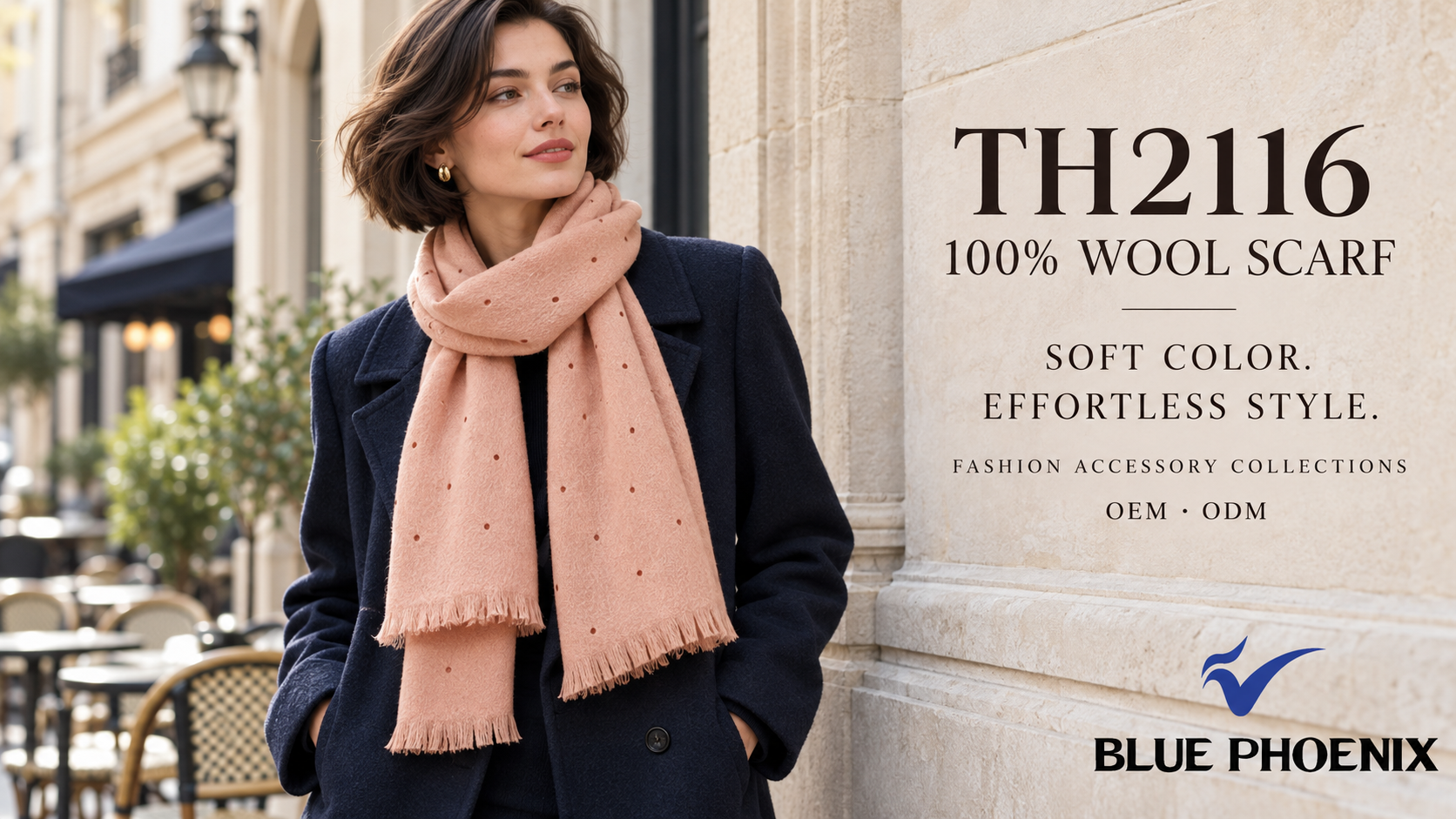
Woman wearing a peach-pink TH2116 wool scarf with small perforated details and short fringe over a navy coat.
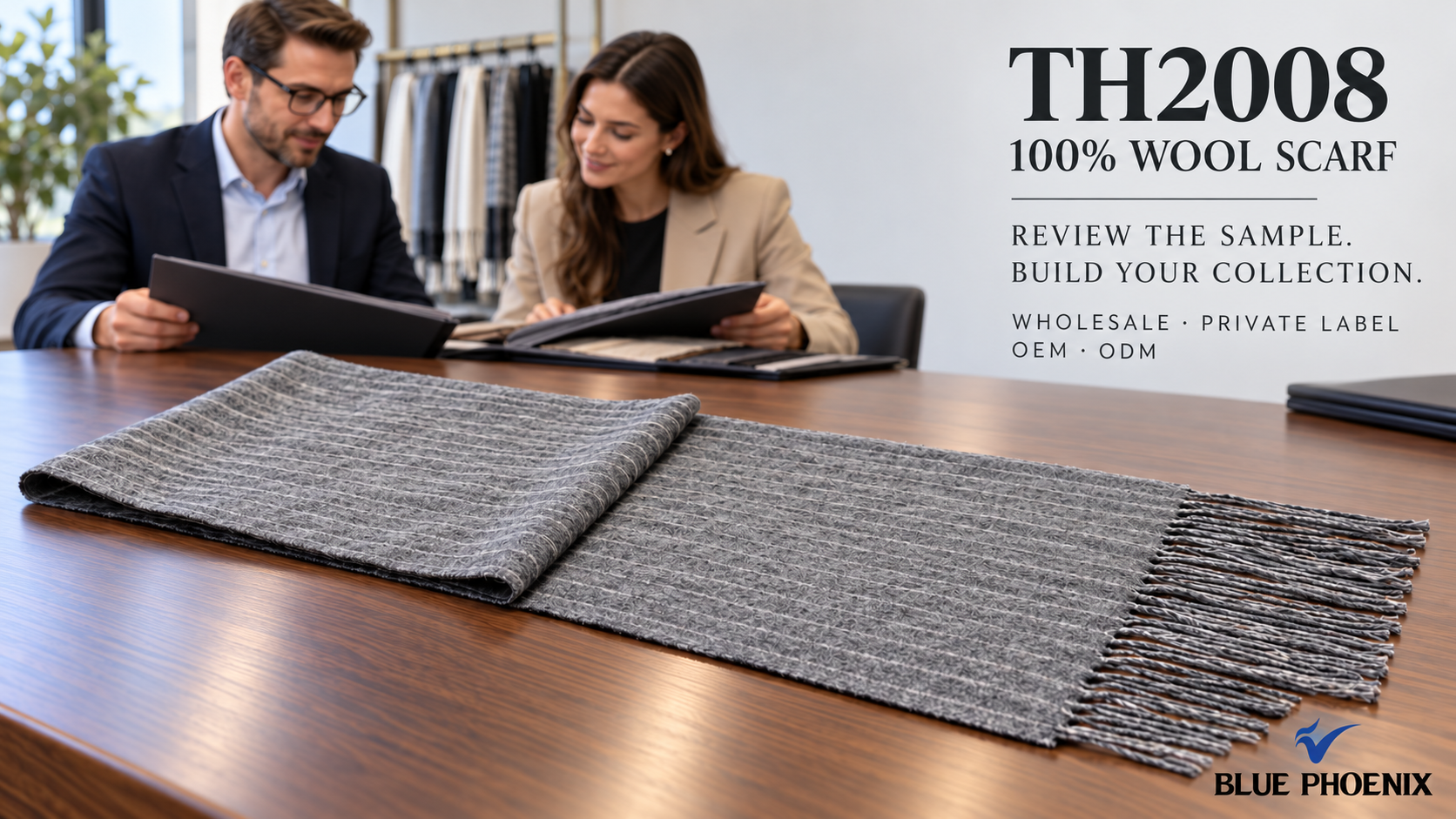
Grey TH2008 wool scarf with fine light stripes and twisted fringe displayed on a table during a wholesale sample review.
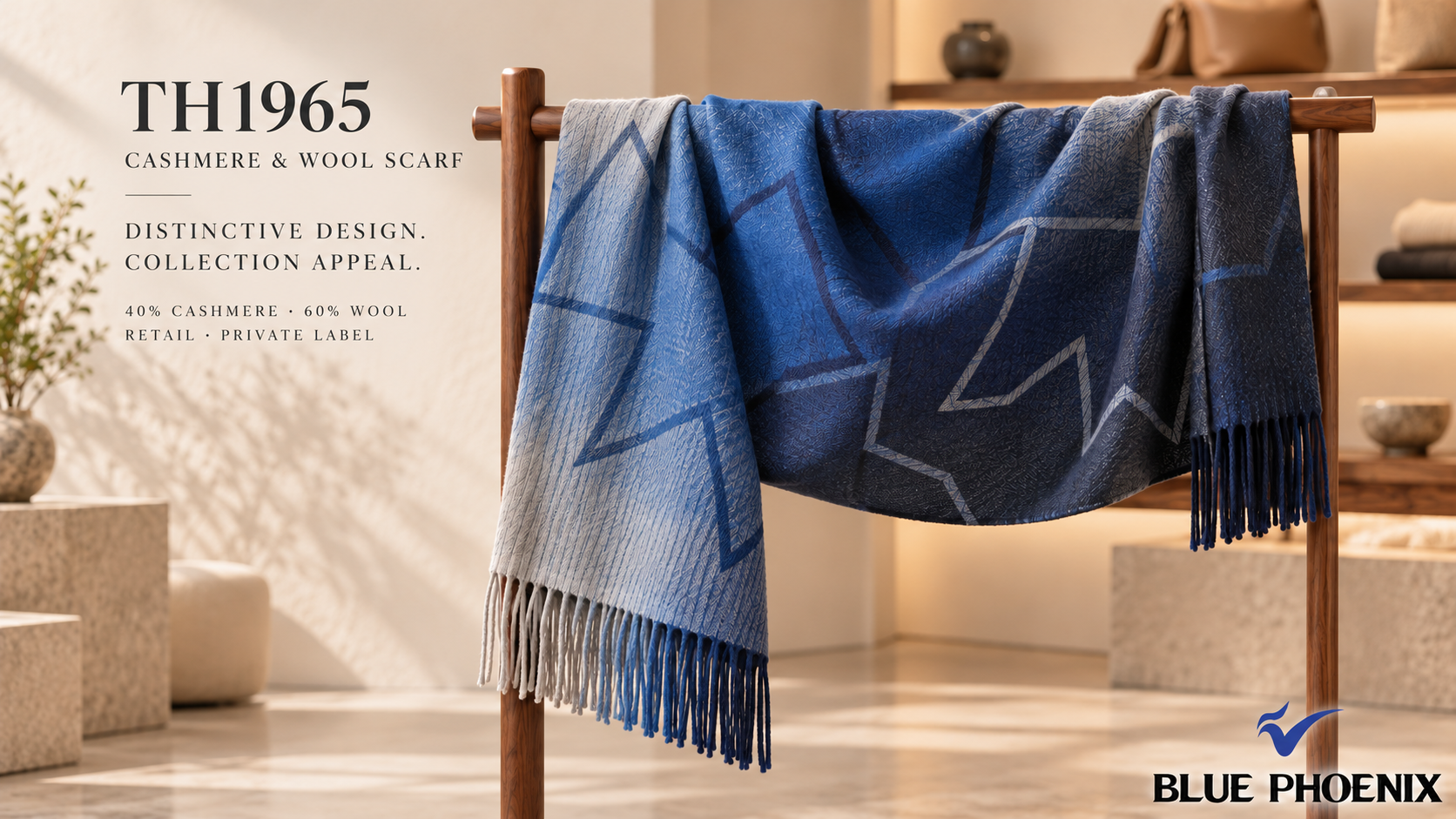
Blue gradient TH1965 cashmere and wool scarf with outlined star motifs and fringe draped over a wooden display stand.
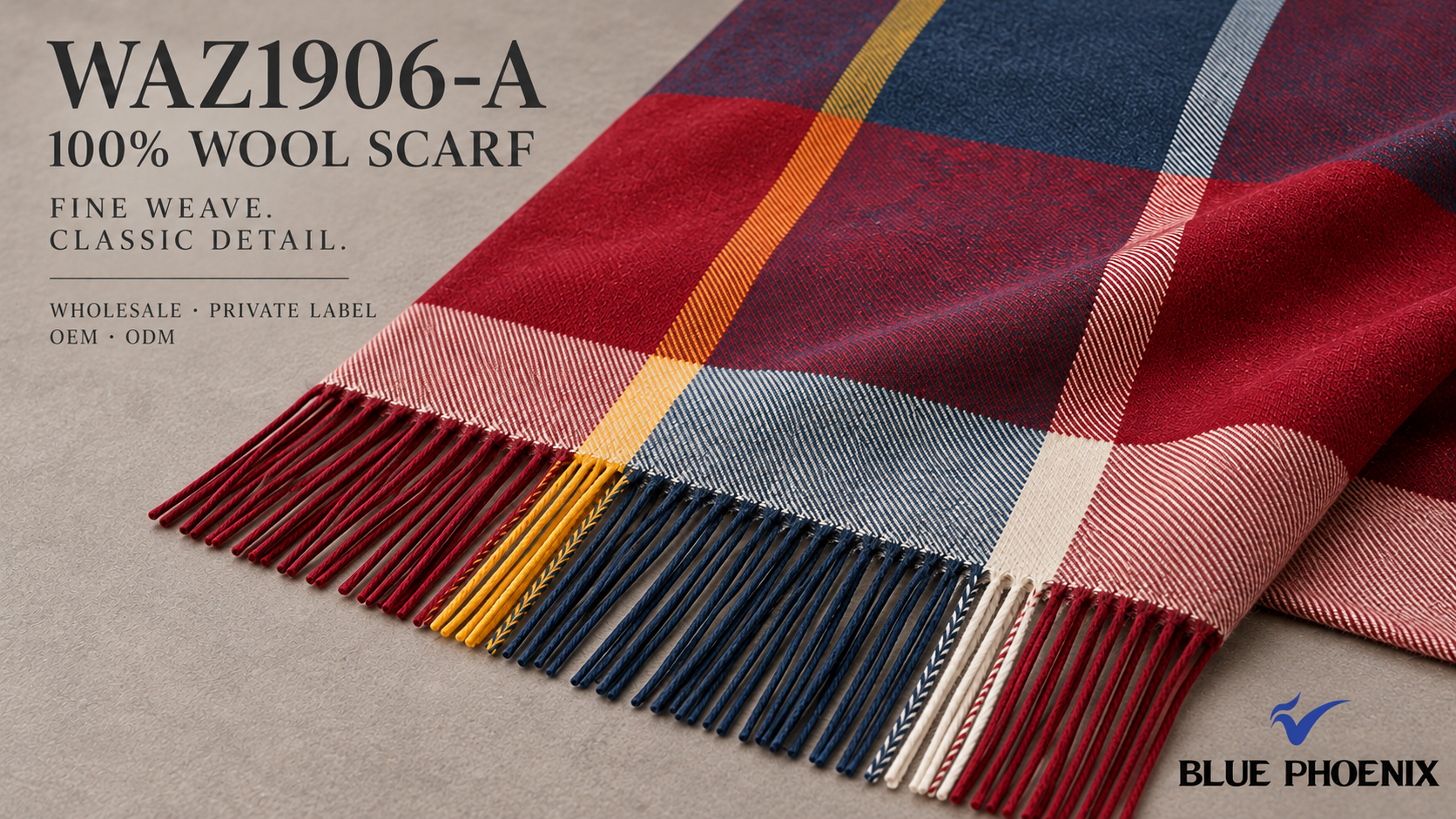
Close-up of a WAZ1906-A wool scarf featuring red, navy, cream and mustard plaid with multicolored twisted fringe.

Man wearing a grey WAZ1902-A wool scarf with blue end stripes and grey fringe while seated in an airport lounge.
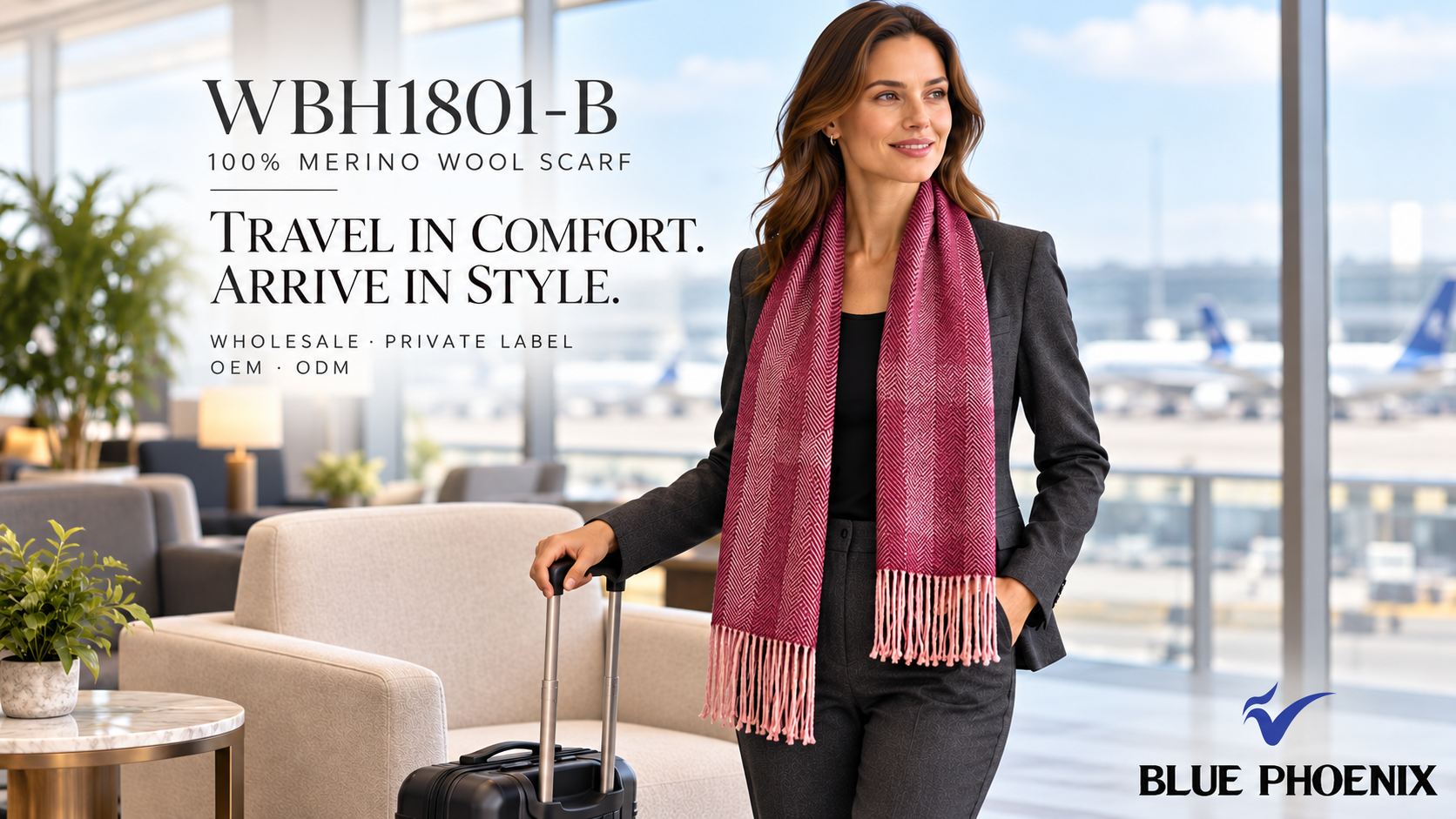
Woman wearing a burgundy and pink WBH1801-B merino wool herringbone scarf with pale pink fringe beside luggage in an airport lounge.
Include composition, body dimensions, fringe, target weight, color, design details, labels, care instructions, packaging and agreed inspection criteria.
The supplied tag states 100% wool, a 58 × 193 cm body, 2 cm fringe at each short end and a 255 g piece weight.
Review hole size, shape, spacing, staggered arrangement, edge offsets and the condition of the surrounding fabric against the approved sample.
Colors, dimensions, perforation layouts, labels and packaging can be reviewed, subject to feasibility, order requirements and development-sample approval.
No. Samples and courier delivery are chargeable. Costs and preparation arrangements are confirmed before proceeding.
Approve the physical sample, specification, color, perforation layout, labels, care instructions, packaging and inspection requirements.
1. What is a private-label wool scarf?
It is a wool scarf supplied with approved buyer-specific branding and product requirements.
2. What material is confirmed for TH2116?
The supplied sample tag specifies 100% wool.
3. Is merino wool confirmed for this model?
No specific wool breed is identified on the supplied tag.
4. Is a fiber micron value confirmed?
No fiber fineness is recorded on the supplied tag.
5. What body dimensions are recorded?
The scarf body measures 58 × 193 cm.
6. How should fringe be specified?
List 2 cm fringe at each short end separately from the body dimensions.
7. What does the 255 g figure describe?
It describes the reference piece weight.
8. Does a reference sample establish production tolerances?
No. Bulk-production targets and allowable variation require agreement.
9. Is 255 g a GSM measurement?
No. Piece weight and fabric GSM are different measurements.
10. What is the reference color?
The product photographs show a peach-pink shade.
11. How should the color be approved?
Use a physical sample or agreed color reference.
12. What is the perforated design?
Small round openings are arranged in staggered rows across the scarf body.
13. Is one folded photograph enough for approval?
No. Include overall images, close-ups and a physical sample.
14. Can the hole arrangement be changed?
Changes require feasibility review and approval of a development sample.
15. What is needed for custom labels?
Provide artwork, wording, dimensions, colors, placement and attachment instructions.
16. How should care instructions be confirmed?
Evaluate the finished product and intended cleaning process before approving the care label.
17. Can gift packaging be developed?
Packaging can be reviewed around the approved folded dimensions and branding requirements.
18. What determines MOQ and lead time?
They depend on the approved specification, customization, quantity and production schedule.
19. Which quotation terms are available?
FOB, CIF and DDP enquiries can be reviewed according to the project and destination.
20. What are the standard payment terms?
Standard payment terms are 30% deposit and 70% before shipment.
Wool Scarves — Review wool products for wholesale accessory sourcing.
Cashmere Scarves — Explore a separate natural-fiber sourcing category.
Blended Scarves — Compare alternative material specifications.
Camel Down Scarves — Review additional natural-fiber collection options.
TH2116 Perforated Pink Wool Scarf — Review the featured scarf for sampling and private-label development.
TH2008 Wool Stripe Scarf — Compare a grey mixed-stripe design.
TH1965 Cashmere Wool Gradient Scarf — Explore a blended-fiber alternative with gradient colors and star-pattern detail.
WAZ1906-A Wool Plaid Scarf — Review a multicolor plaid option for accessory collections.
WAZ1902-A Wool Stripe Scarf — Compare grey transverse bands, blue terminal stripes and twisted fringe.
WBH1801-B Merino Wool Herringbone Scarf — Explore a burgundy and blush-pink herringbone design with pale-pink fringe.
Send your model, quantity, color breakdown, specifications, labels, packaging requirements, destination and delivery schedule to BLUE PHOENIX.
Samples and courier delivery are chargeable. FOB, CIF and DDP quotations can be reviewed. Standard payment terms are 30% deposit and 70% before shipment.
Email: jamesli@shbluephoenix.com
WhatsApp: +86 18017830390
WeChat: bluephoenix66
Website: www.shbluephoenix.com

Blue Phoenix Blankets dedicated to strict quality control of blankets and scarves products and thoughtful customer service, our custom blankets wholesale products are exported to clients in such countries and regions as United states, Europe, Australia, Russia, Germany, Japan.
Copyright © 2026 Shanghai Rainbow Enterprise Development Co., Ltd. - All Rights Reserved.