High-Quality Wholesale Blankets Manufacturer & Supplier in China with custom design service - Blue Phoenix Blankets
Language
High-Quality Wholesale Blankets Manufacturer & Supplier in China with custom design service - Blue Phoenix Blankets
Developing custom airline blankets involves decisions about fabric, dimensions, colour, woven artwork, labels and packaging. Each element affects how the finished blanket looks, folds and presents to the buyer or passenger.
For airline procurement teams, inflight-product suppliers and private label brands, a clear development brief connects these decisions. It gives the supplier a practical basis for reviewing the design, preparing a quotation and producing a sample.
The BLUE PHOENIX TDT2002 modacrylic airline blanket provides a starting point. The standard sample is made from 100% modacrylic, measures 120 × 170 cm and weighs approximately 435 g per piece. It features a blue body, contrasting woven jacquard detailing and hemmed edges, with a minimum order quantity of 3,000 pieces.
Define the Product Specification Before Customising the DesignStart an OEM airline blanket project by confirming the intended application and core product requirements.
A buyer should identify the required composition, finished dimensions, target piece weight, construction and edge finish. These details establish the product on which the custom design will be developed.
For TDT2002, the reference specification is 100% modacrylic, 120 × 170 cm and approximately 435 g per piece. The calculated fabric weight is approximately 213 GSM.
If the buyer requests different dimensions or weight, the supplier should review the revised specification before finalising the artwork. A larger size can change the position of decorative elements, the folded presentation and the individual packaging requirements.
A written specification also helps buyers compare quotations on a consistent basis.
Develop a Coordinated Colour DirectionColour development should consider the main blanket body and the contrasting woven design together.
TDT2002 uses a blue ground with a contrasting decorative section. Buyers developing a custom modacrylic blanket can discuss alternative colour combinations according to their collection or cabin-textile requirements.
Provide physical colour references or clearly identified colour standards where available. Digital images are useful for communicating an initial direction, but final approval should use an agreed physical reference.
Review the colour combination across a broad fabric area. A small swatch may not fully communicate the balance between the plain body and the decorative section of an opened blanket.
Keep the approved colour reference with the sample record so it remains available during production and repeat-order discussions.
Prepare Artwork for Woven Jacquard DevelopmentA custom jacquard blanket forms its design through weaving. Artwork therefore needs to be reviewed for the proposed fabric construction.
Buyers should provide a clear design file showing the intended motif, lettering where required, colour arrangement and placement. State the desired artwork dimensions and its distance from the finished edges.
Fine lines, small lettering and closely spaced details may require adjustment during development. The supplier can review the artwork’s feasibility, but any changes to the buyer’s design should be confirmed before sampling.
For an airline blanket with a custom woven design, review the artwork in two formats: fully opened and folded for presentation. A design that looks balanced on the complete blanket may become partly hidden when packed.
The approved sample should establish the final motif proportions, orientation and location.
Confirm Edge Finishing and Corner AppearanceEdge finishing is part of the product design and should appear in the written specification.
The standard TDT2002 sample has hemmed edges without fringe or satin binding. The folded and sewn perimeter creates a simple outline around the woven fabric.
When placing artwork near an edge, allow for the hem and corner construction. Important design elements should remain visible after finishing rather than being folded into the seam.
If a buyer requests a different edge treatment, review it as a product-development change. The revised finish can affect the appearance, dimensions, fabric handling and quotation.
During sample approval, inspect the stitch line, hem width, corner folds and relationship between the decorative section and the finished edge.
Plan Brand, Composition and Care LabelsA private label airline blanket may require several labels, each serving a different purpose.
The brand label identifies the buyer or collection. The composition label states the agreed material. The care label communicates the confirmed instructions for the finished product.
For TDT2002, the correct material description is 100% modacrylic. The quotation, purchase order and approved composition label should use this description consistently.
Buyers should provide label artwork, wording, dimensions and preferred placement during development. Review the attachment position on the actual sample to confirm how the label appears when the blanket is opened, folded and packed.
Care instructions should be established for the approved construction and intended care process. Buyers planning a particular laundry method should provide its conditions for evaluation before approving the care label.
Any destination-specific labelling requirements should be included in the project brief.
Develop Packaging Around the Actual Folded BlanketPackaging should be evaluated using the approved folding method and a physical blanket sample.
Standard TDT2002 packing consists of one blanket per plastic bag, packed into export cartons. Buyers can discuss alternative individual packing, inserts and carton markings according to the project requirements.
Confirm which part of the blanket should face outward when folded. This affects the visibility of the jacquard design and brand label.
For orders containing several colours or label versions, establish a clear item reference for each variation. Confirm the quantity breakdown and how each version will be identified on its individual packing and export carton.
Carton dimensions, packed quantities, gross weight and shipment volume should be confirmed against the final packing plan.
Approve a Complete Production ReferenceA complete approval process brings the product and presentation details together before bulk manufacturing.
The approved reference should cover:
Material composition and woven construction.
Finished dimensions and target piece weight.
Body colour and contrasting yarn colours.
Jacquard artwork, scale and placement.
Hem and corner finishing.
Labels, wording and attachment positions.
Folding, individual packaging and carton markings.
Identify the sample version and record any outstanding corrections. Approval of the blanket fabric should not be treated as approval of labels or packaging that the buyer has not reviewed.
Any required testing, inspection or documentation should be agreed separately as part of the order requirements.
Plan MOQ, Sampling and Production TimingThe TDT2002 minimum order quantity is 3,000 pieces. Buyers should provide the proposed quantity breakdown when requesting multiple colours, designs or packaging versions so feasibility can be reviewed.
Sample and courier charges apply. Custom artwork review, sample preparation and buyer revisions should be included in the development schedule.
The indicative production lead time is approximately 50 days, with the final schedule confirmed according to sample approval, deposit receipt, order details and production availability.
Payment terms are 30% deposit and 70% balance before shipment. FOB, CIF and DDP quotations can be reviewed according to the destination and shipment requirements.
When planning a required arrival date, allow separately for development, bulk production and transport.
ConclusionA well-defined custom airline blanket project connects material specifications with colour, jacquard artwork, edge finishing, labels and packaging. Approving these details together creates a clear production reference.
The TDT2002 100% modacrylic airline blanket offers a starting format of 120 × 170 cm and approximately 435 g per piece, with woven jacquard detailing and hemmed edges. Its OEM/ODM development options and 3,000-piece MOQ provide a basis for buyers developing a coordinated private label cabin-textile collection.
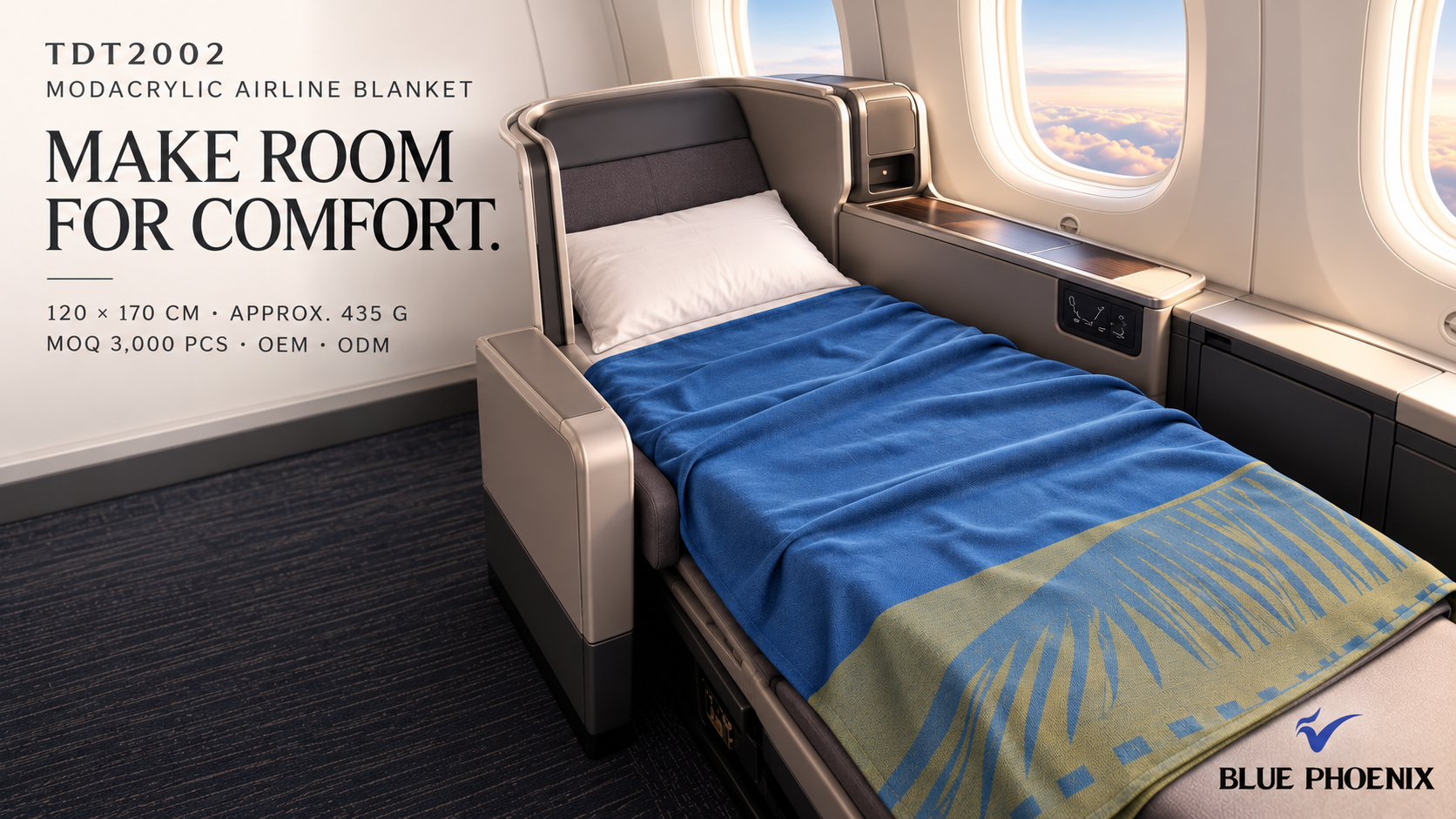
TDT2002 Modacrylic Airline Blanket
100% modacrylic blanket with contrasting woven jacquard detailing and hemmed edges. Size: 120 × 170 cm. Approx. 435 g per piece. MOQ: 3,000 pieces.
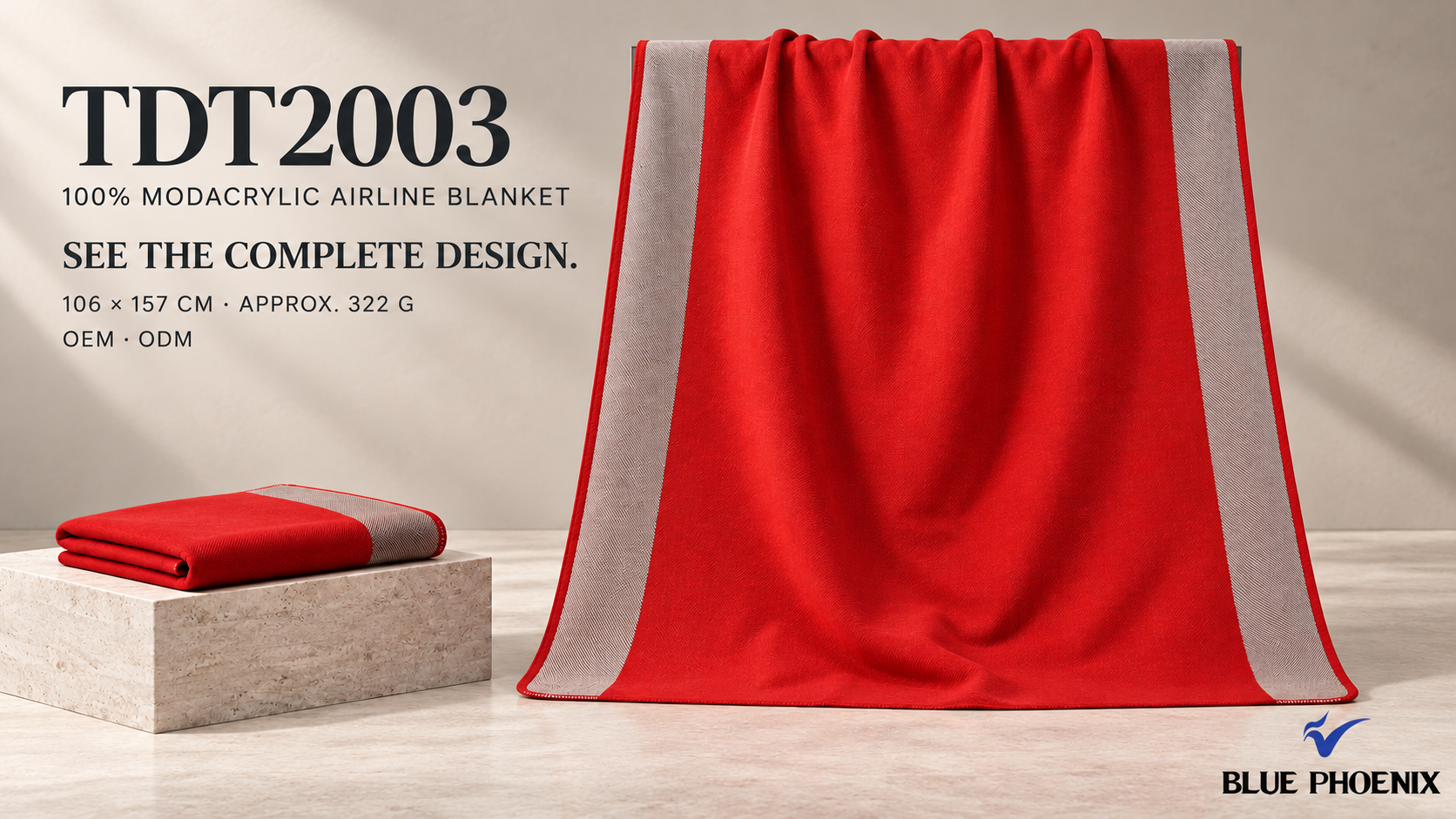
TDT2003 Red Modacrylic Airline Blanket
100% modacrylic airline blanket featuring a red body, contrasting grey-beige border bands and matching overlocked edges for cabin-textile sourcing.
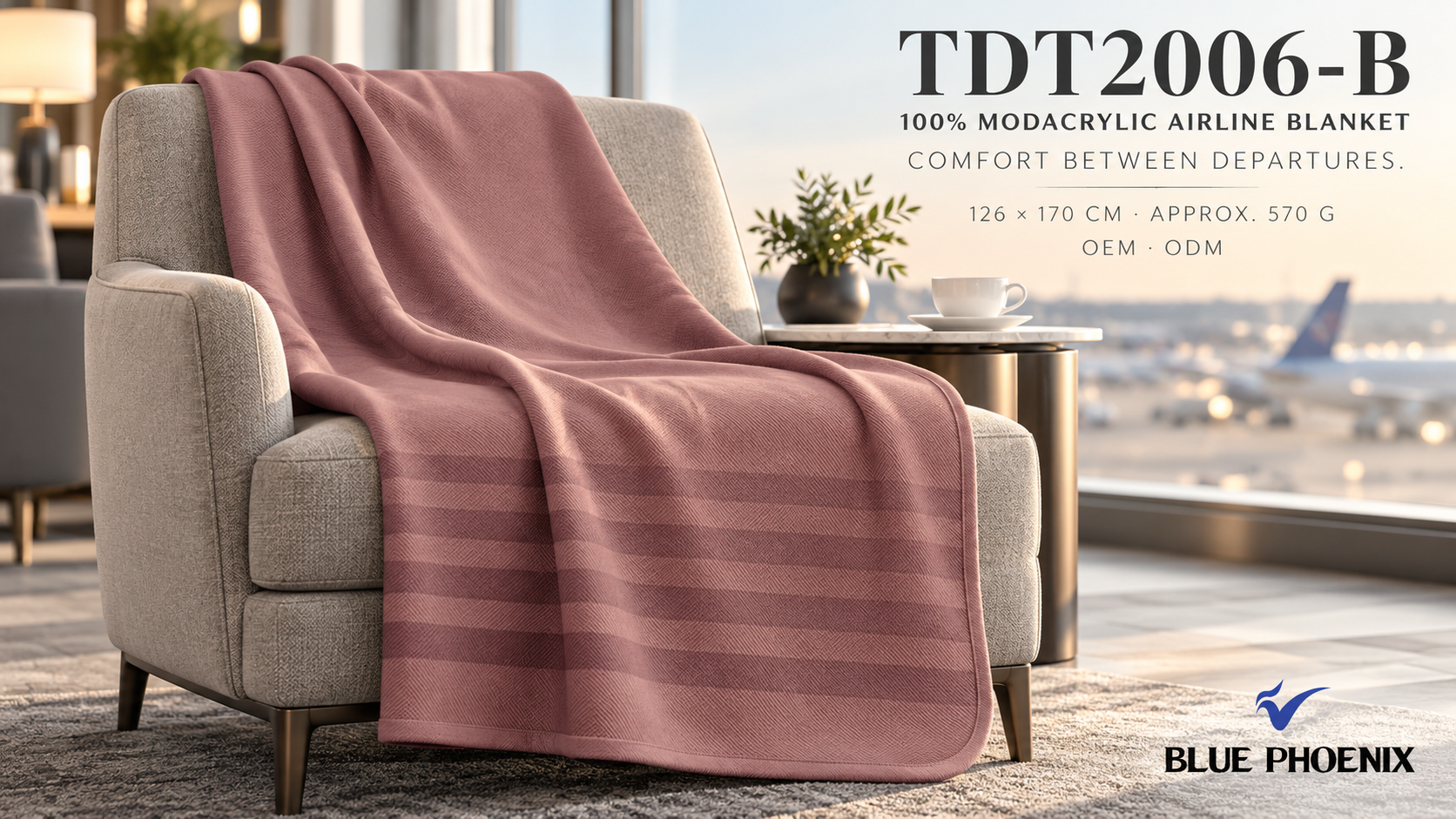
TDT2006-B Modacrylic Airline Blanket
Dusty-rose 100% modacrylic blanket with woven stripe detailing for airline passenger-comfort collections and private label development.
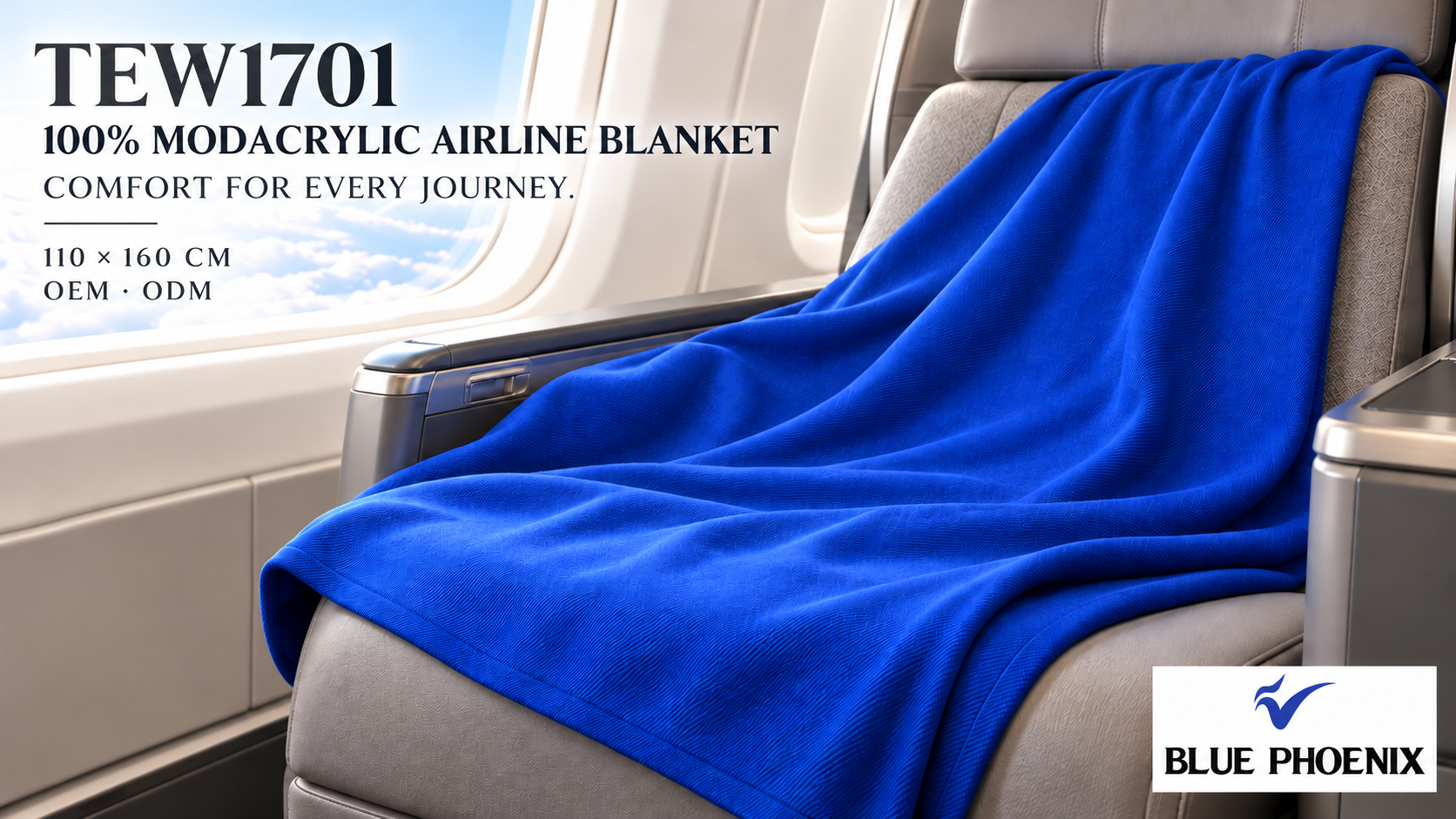
TEW1701 Solid Blue Modacrylic Airline Blanket
100% modacrylic blanket with a solid royal-blue body, fine diagonal woven texture and matching stitched hems. Size: 110 × 160 cm.
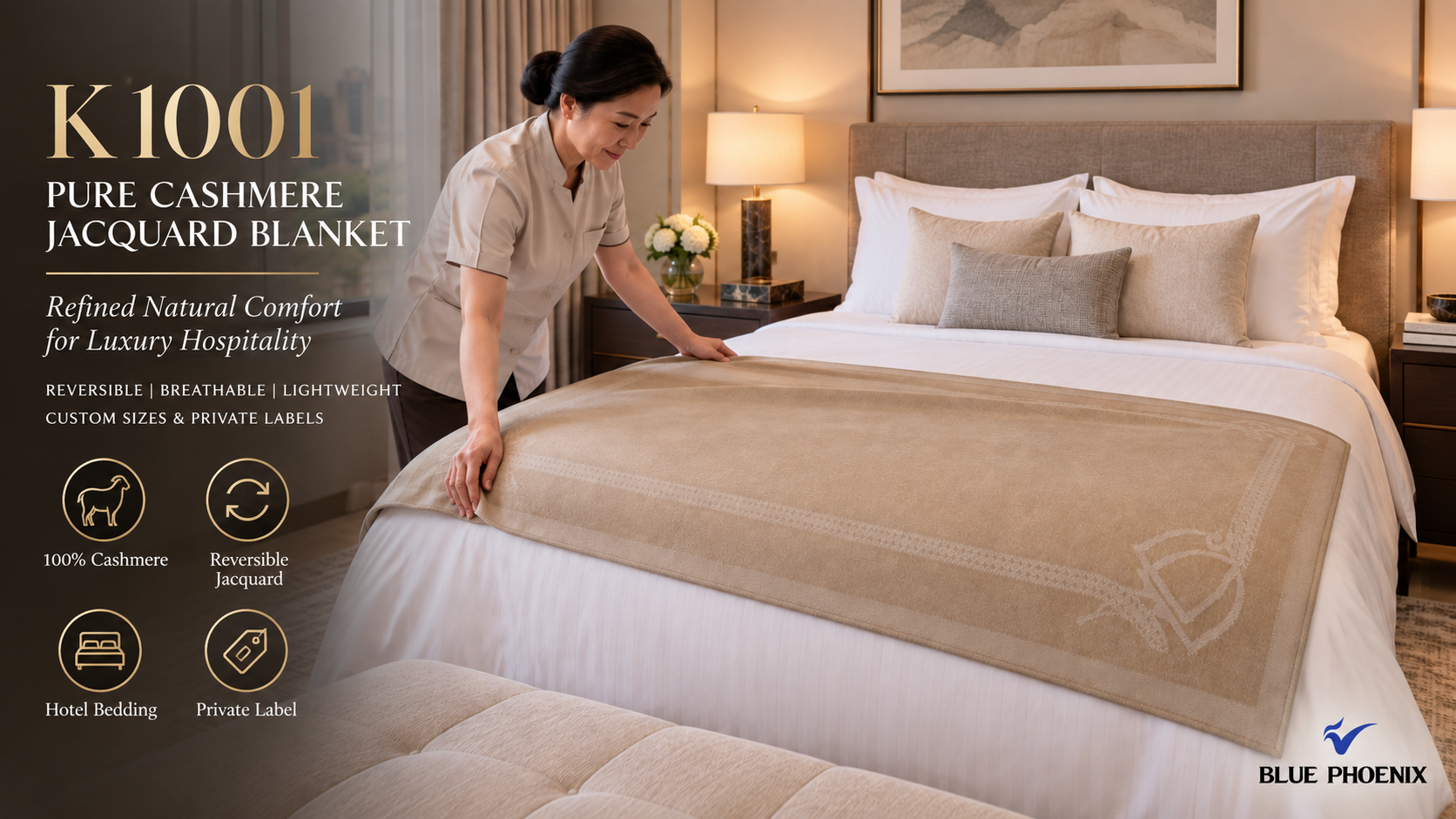
K1001 Reversible Cashmere Jacquard Blanket
100% cashmere blanket with a reversible equestrian jacquard design for premium hospitality, private label collections and luxury gifting.
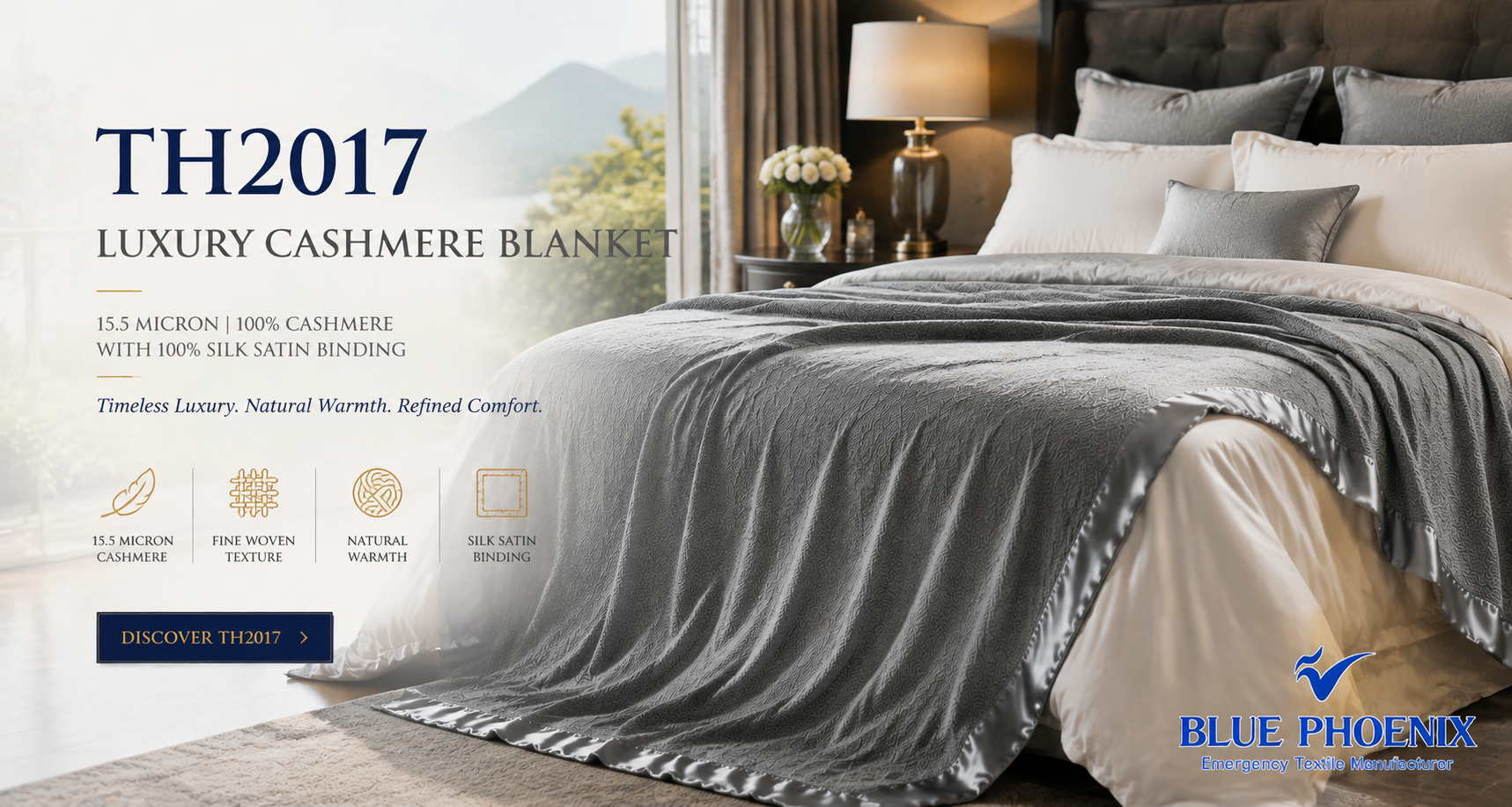
TH2017 Cashmere Blanket with Silk Satin Edge
100% cashmere blanket featuring fine 15.5-micron fibres and silk satin edging for premium bedding, private label collections and luxury gifts.
Yes. Buyers can discuss custom colours, dimensions, jacquard artwork, labels and packaging. Each requirement is subject to feasibility review, sampling and final order confirmation.
The standard sample uses 100% modacrylic, measures 120 × 170 cm and weighs approximately 435 g per piece. It has woven jacquard detailing and hemmed edges without fringe or satin binding.
Provide a clear design file showing the proposed artwork, colours, dimensions, orientation and placement. Fine details and lettering must be reviewed for the intended woven construction.
Labels can be discussed during development. Buyers should approve the wording, artwork, label dimensions, attachment method and placement before production.
Packaging can be reviewed according to the approved folding method and distribution requirements. Standard packing is one blanket per plastic bag, packed into export cartons.
The TDT2002 MOQ is 3,000 pieces. Sample and courier charges apply. Quantity breakdowns for custom versions should be reviewed during quotation.
Prepare a brief covering the intended application, composition, dimensions, target weight, quantity, artwork, labels, packaging and delivery requirements.
The dimensions, construction and finishing influence artwork placement, folded presentation and packaging. Confirming them first provides a consistent development reference.
Alternative colours can be discussed and reviewed through sampling. Final production colours should follow the agreed physical references.
Provide physical swatches or clearly identified colour standards where possible, together with the proposed body and contrasting design colours.
It is a blanket whose decorative design is formed through the woven construction rather than applied as a surface print.
Lettering needs technical review. Its size, spacing and detail may require adjustment for the proposed weave, subject to buyer approval.
State the artwork dimensions, orientation and distance from the finished edges. Confirm the placement on the sample.
Folding changes which areas remain visible. Reviewing the actual fold helps confirm the presentation of artwork and labels.
Custom dimensions can be reviewed. Any resulting changes to weight, design proportions, packaging and pricing should be confirmed during development.
At the same GSM, increasing the blanket area increases its approximate piece weight. Dimensions, GSM and piece weight should be reviewed together.
The stated 435 g weight divided by its 2.04-square-metre area gives approximately 213 GSM.
TDT2002 has hemmed edges, with no fringe or satin binding.
Yes. Artwork close to the perimeter must allow for the hem and corner folds so important elements remain visible after finishing.
For the confirmed TDT2002 specification, the material description is 100% modacrylic.
Approve it after confirming the finished construction and evaluating the intended care process. Provide any specific laundry conditions during development.
Assign a clear item reference to each colour, design, label or packaging version and confirm the quantity breakdown and carton markings.
It should cover fabric, colours, dimensions, weight, artwork, finishing, labels, folding and packaging, with any outstanding items recorded separately.
Identify the sample version, requested corrections and final approved production reference so all parties work from the same specification.
No. Required finished-product testing and documentation must be reviewed separately against the buyer’s project requirements.
Provide the full product specification, artwork, quantity breakdown, labels, packaging, delivery destination, preferred trade terms and requested schedule.
Explore additional material directions for custom blanket and private label collections:
Wool Blankets — Natural-fibre options for woven blanket development.
Polyester Blankets — Alternative material options for commercial textile projects.
Cashmere Blankets — Products for premium private label and gifting collections.
Blended Blankets — Blended-fibre products for different design and specification requirements.
Review the first four modacrylic products for airline-textile development. The final two provide natural-fibre examples for broader premium collections.
TDT2002 100% Modacrylic Airline Blanket
The development reference discussed in this guide, with woven jacquard detailing and hemmed edges.
TDT2003 Red Modacrylic Airline Blanket
An alternative red design for buyers comparing modacrylic airline blanket options.
TDT2006-B Modacrylic Airline Blanket
A dusty-rose model with woven stripe detailing for sample comparison.
TEW1701 Solid Blue Modacrylic Blanket
A solid-colour option for buyers seeking a simpler woven appearance.
K1001 Cashmere Reversible Equestrian Jacquard Blanket
A natural-fibre jacquard example for premium private label and gift development.
TH2017 Cashmere Blanket with Silk Satin Edge
An alternative material and edge-treatment direction for premium blanket collections.
Share your artwork, colour references, target dimensions, quantity, labels and packaging requirements with BLUE PHOENIX. We can review a TDT2002-based OEM/ODM project and confirm the proposed sampling steps.
Reference specification: 100% modacrylic, 120 × 170 cm, approximately 435 g per piece.
MOQ: 3,000 pieces.
Samples: Sample and courier charges apply.
Payment: 30% deposit, 70% balance before shipment.
Quotation terms: FOB, CIF or DDP, subject to destination and shipment details.
Email: jamesli@shbluephoenix.com
WeChat: bluephoenix66

Blue Phoenix Blankets dedicated to strict quality control of blankets and scarves products and thoughtful customer service, our custom blankets wholesale products are exported to clients in such countries and regions as United states, Europe, Australia, Russia, Germany, Japan.
Copyright © 2026 Shanghai Rainbow Enterprise Development Co., Ltd. - All Rights Reserved.