High-Quality Wholesale Blankets Manufacturer & Supplier in China with custom design service - Blue Phoenix Blankets
Language
High-Quality Wholesale Blankets Manufacturer & Supplier in China with custom design service - Blue Phoenix Blankets
Choosing a cashmere blanket starts with how it will be used. A light sofa throw, a generous bed layer and a private-label gift collection need different dimensions, constructions and presentation.
Rather than relying on a description such as “luxury” or “premium,” compare the finished blanket’s composition, coverage, weight, drape, workmanship and care requirements. These details help establish whether the product fits your needs and budget.
This guide provides a practical selection process for home buyers, retailers, hospitality projects and businesses developing wholesale cashmere blanket collections.
A cashmere throw is often selected for a sofa, reading chair, personal comfort layer or decorative display. A bed blanket needs sufficient coverage for the intended mattress and the desired amount of overhang.
Do not rely only on size names such as “queen” or “king.” Their interpretation can vary between markets and suppliers. Compare the actual centimetre or inch measurements.
For a sofa throw, think about whether it will cover one person, drape across an armrest or extend over the back of the sofa. For a bed blanket, measure the mattress and decide how far the blanket should fall at the sides and foot.
Begin with the required coverage, then select a product that provides it.
Check whether the blanket is 100% cashmere or a cashmere blend. Both can serve a commercial purpose, but their composition should be stated accurately.
For a blend, request the complete fibre percentages. A product described only as “cashmere feel” does not establish cashmere content.
If the blanket has a separate edging material, distinguish that trim from the body fabric. A cashmere body with silk satin edging should describe both components clearly.
For wholesale orders, agree on any required independent composition verification. Appearance and hand feel alone cannot confirm fibre content.
Piece weight is the mass of one finished blanket. GSM means grams per square meter and describes fabric mass per unit area.
A larger blanket can weigh more than a smaller blanket made from the same fabric. This does not mean that the larger product uses a thicker or better textile.
For an approximate comparison, divide the textile weight in grams by its area in square meters. Confirm whether the quoted weight includes fringe, binding, labels or packaging before using the result.
GSM is useful for describing a specification, but it is not a direct warmth rating or a complete quality measure. There is no universal GSM band that makes every cashmere blanket suitable for a particular season.
A woven cashmere blanket can use different fabric structures and decorative techniques. Plain, twill and jacquard descriptions help explain the construction or design, but they do not automatically establish thickness or warmth.
A twill blanket is not necessarily heavier than a plain-weave blanket. Yarn, fabric density, finishing and dimensions must also be considered.
Open the sample and review how it hangs over an edge or folds in the hand. A fluid drape may suit a personal throw, while a more defined structure may fit a particular bed or interior collection.
For textured designs, inspect the consistency of the surface. For jacquards and checks, review pattern placement, scale and the reverse appearance.
Initial softness is only one part of sample approval. Review the fabric fully opened and examine its consistency, edge stability and overall appearance.
Check for unusually thin areas, visible irregularities, loose threads and inconsistent finishing. Compare the sample under suitable lighting rather than relying only on a product photograph.
A particularly soft initial finish does not establish long-term surface appearance. If pilling, dimensional stability or colourfastness matters to the collection, define the relevant evaluation before production.
Comfort preferences differ, so review the sample in a way that reflects the intended use and customer expectations.
Descriptions such as “Grade A,” “A+” and “premium grade” should not replace a clear specification. Ask the supplier what the term means and which measurable characteristics support it.
Where fibre diameter or length is stated, request the relevant information and understand whether it refers to the raw material or the finished product.
No single grade name proves the quality of the complete blanket. Yarn preparation, construction, finishing, edge workmanship and care performance remain important.
Likewise, a higher yarn ply number does not automatically guarantee greater durability. Compare the finished construction and any agreed performance results.
Fringe, stitched edges and separate binding create different visual and handling characteristics.
Fringe: Check consistency, attachment and the transition from the fabric body.
Stitched edges: Examine seam continuity, corner shape and whether the perimeter lies naturally.
Satin edging: Review the trim material, attachment, corner workmanship and care compatibility.
For patterned blankets, confirm how the motif meets the finished edges. A reversible design should be examined on both sides.
The approved physical sample should establish the finishing reference for bulk production.
Follow the care instructions for the specific finished blanket. Do not assume all cashmere blankets can be hand washed, machine washed or dry cleaned in the same way.
If professional cleaning is specified, consider the cost and availability. If home washing is essential, select a product with an appropriate care instruction and confirm the approved process.
Drying requirements matter as well. Do not assume tumble drying is permitted. Handle the textile gently and follow the specified drying method.
For hospitality programmes, discuss the actual cleaning process before selecting the product. A decorative suite throw and a textile intended for frequent commercial laundering require different evaluations.
Neutral shades, statement colours, checks, textured surfaces and decorative jacquards can all fit a cashmere collection. Choose a design that supports the intended room, retail assortment or gifting programme.
Compare colour with a physical reference. Screen settings, photography and lighting can alter its appearance.
Natural or undyed colour does not, by itself, establish organic certification or a complete sustainability claim. Any certification or sourcing statement should relate to supporting documentation for the relevant scope.
For repeat orders, retain the approved colour and design references together with the product specification.
For wholesale cashmere blankets, specify the intended format, composition, dimensions, piece weight, construction, colour, design layout and edging.
Include care requirements and any testing or inspection criteria. Agree on tolerances and the measurement basis before production.
For private-label cashmere blankets, review brand labels, care information and packaging together with the textile. Confirm the folded dimensions before approving gift boxes or printed sleeves.
Request a current quotation for the final specification and quantity. Samples, minimum quantities, development costs and production timing should be confirmed for the selected model.
| Selection Point | What to Confirm |
| Use | Sofa throw, bed layer, gifting, retail or hospitality |
| Composition | Pure cashmere or the complete blend percentages |
| Coverage | Actual finished dimensions and desired overhang |
| Weight | Piece weight, measurement basis and tolerances |
| Construction | Weave, texture, drape and reverse appearance |
| Finishing | Fringe, stitched edges or separate binding |
| Care | Approved cleaning and drying method |
| Quality Review | Representative sample and required performance checks |
| Presentation | Labels, folding and packaging |
| Commercial Terms | Current quotation, MOQ, samples and production schedule |
Choose a cashmere blanket by matching the finished product to its intended use. Start with coverage and composition, then compare weight, construction, drape, finishing and care.
A grade name, high GSM figure or higher price cannot replace a complete sample review. For commercial collections, an approved sample and clear written specification provide the reference for production and inspection.
BLUE PHOENIX supports buyers developing cashmere blanket collections with different designs and finishing directions. Share your brief to discuss suitable samples, customisation and quotation requirements.
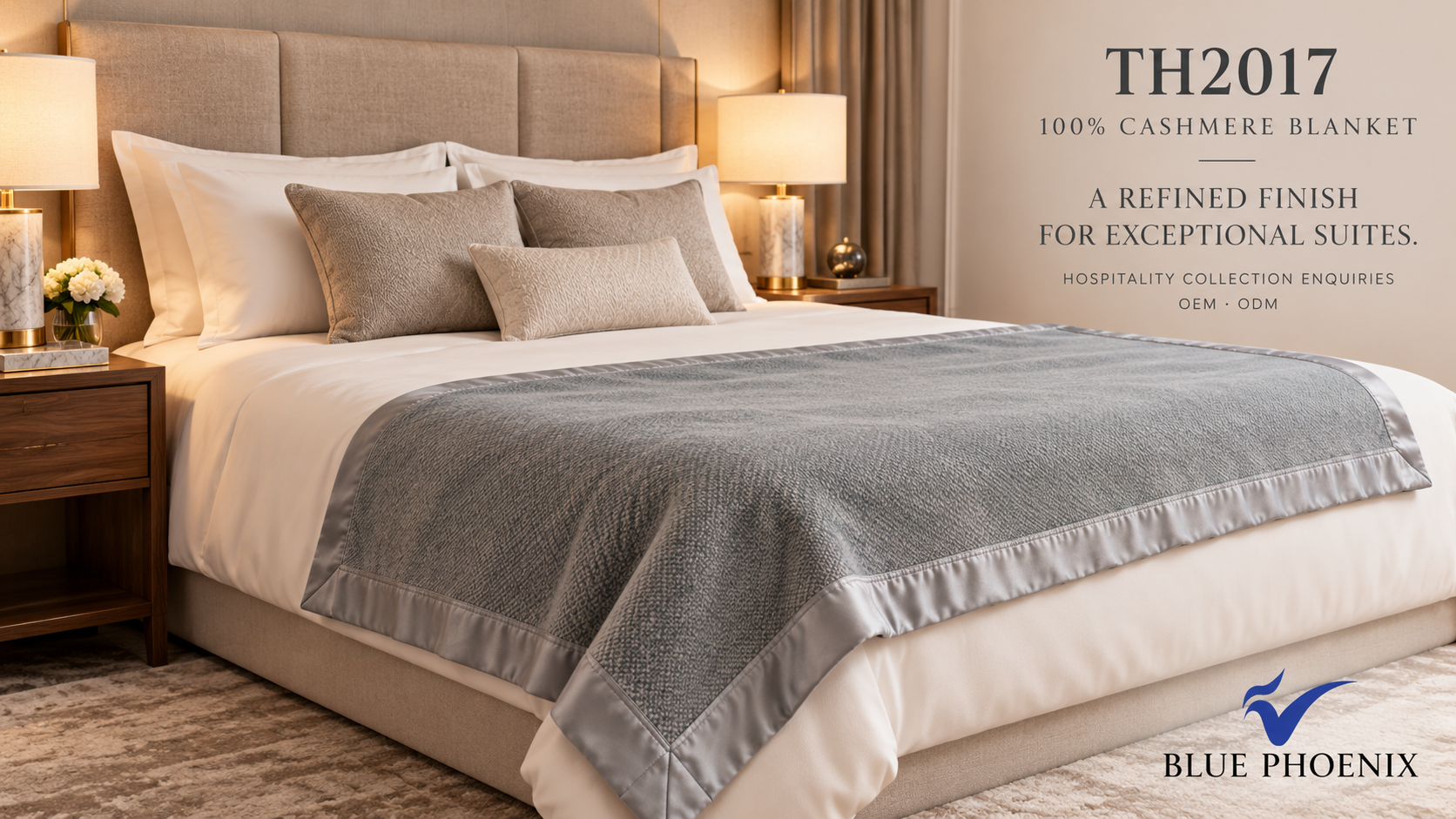
TH2017 Cashmere Blanket with Silk Satin Edge
A satin-edged option for reviewing trim attachment, corners and premium presentation.
.
Define the intended use and required coverage. A sofa throw, bed layer and gift item may need different dimensions, weight and presentation.
No. GSM describes fabric mass per square meter. It does not directly measure warmth or overall quality. Review construction, drape, finishing and suitability together.
No. Yarn, density and finishing also affect the finished textile. Compare actual samples rather than assigning thickness or warmth from the weave name alone.
Choose according to the product brief, budget and required characteristics. Confirm the complete composition and evaluate the finished sample and care requirements.
Ask the supplier to explain the term and supporting specification. A grade description alone does not establish the workmanship or performance of a finished blanket.
Approve a representative sample, written specification, colour, design layout, edging, care information, labels and packaging. Confirm tolerances and any required evaluation before production.
Should a blanket be chosen by size name alone?
No. Compare the actual finished dimensions.
What affects the required bed coverage?
Mattress dimensions, desired overhang and the bedding arrangement.
What is piece weight?
The mass of one finished blanket.
What does GSM mean?
Grams per square meter of fabric.
Can packaging affect a recorded weight?
Yes. Confirm whether packaging and labels are included.
Does more weight prove more warmth?
No. Construction, loft, coverage and use conditions also matter.
Can softness confirm composition?
No. Use a clear declaration and testing where required.
Should blend percentages be disclosed?
Yes. Request the complete composition.
Should trim material be identified separately?
Yes, when it differs from the blanket body.
Is every cashmere blanket woven the same way?
No. Structures and decorative techniques vary.
What should be checked on a reversible design?
Both surfaces, pattern definition and edge finishing.
Does higher yarn ply guarantee durability?
No. Assess the complete construction and relevant performance.
Should fringe be inspected?
Yes. Check consistency and attachment.
What matters with satin edging?
Trim material, attachment, corners and care compatibility.
Can all cashmere blankets be hand washed?
No. Follow the specific finished-product care label.
Does undyed mean certified organic?
No. Certification requires supporting documentation.
Can a screen image establish production colour?
No. Approve a physical colour reference.
Should packaging be sampled?
Yes. Review the folded blanket and packing together.
Do all cashmere designs share the same MOQ?
Do not assume so. Confirm for the selected model and customisation.
What supports a consistent bulk order?
An approved sample, written specification and agreed inspection criteria.
Tags: #CashmereBlanket #CashmereBuyingGuide #CashmereThrow #BlanketSize #BlanketWeight #WovenCashmere #PureCashmere #CashmereBlend #PrivateLabelBlankets #WholesaleCashmere
Best Cashmere Blankets for Comfort and Style — compare design directions, comfort and finishing.
How to Choose a Cashmere Blanket Manufacturer: A B2B Buyer’s Guide — prepare a supplier review and development brief.
Cashmere Blankets — explore different cashmere constructions and designs.
Wool Blankets — compare a separate natural-fibre material direction.
Yak Down Blankets — review additional natural-fibre options.
Camel Blankets — discover camel hair and camel down designs.
Use these designs as sample references for different purchasing requirements. They are not ranked by measured warmth, softness or durability.
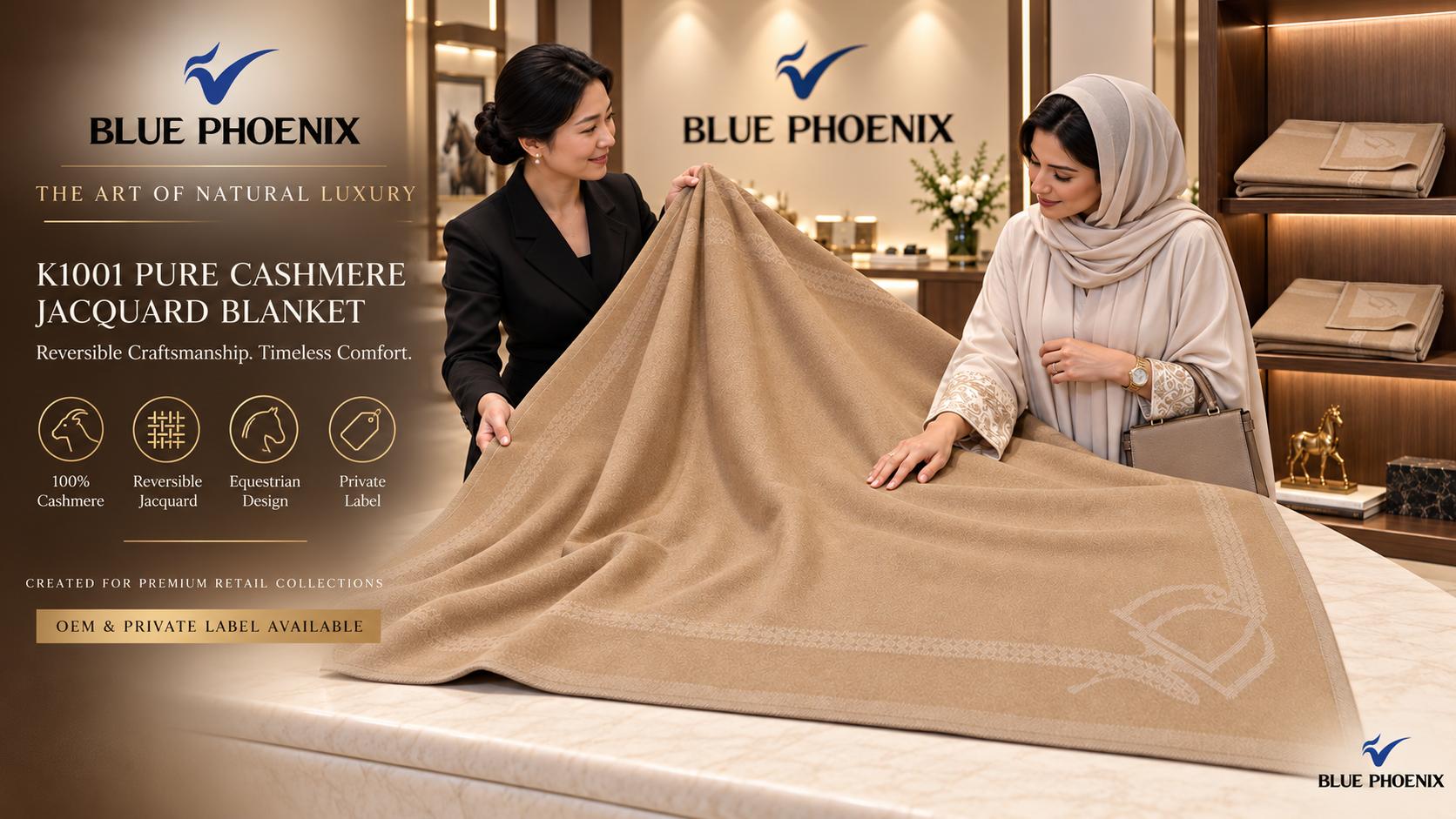
K1001 Reversible Cashmere Jacquard Blanket — compare both surfaces and the equestrian jacquard design.
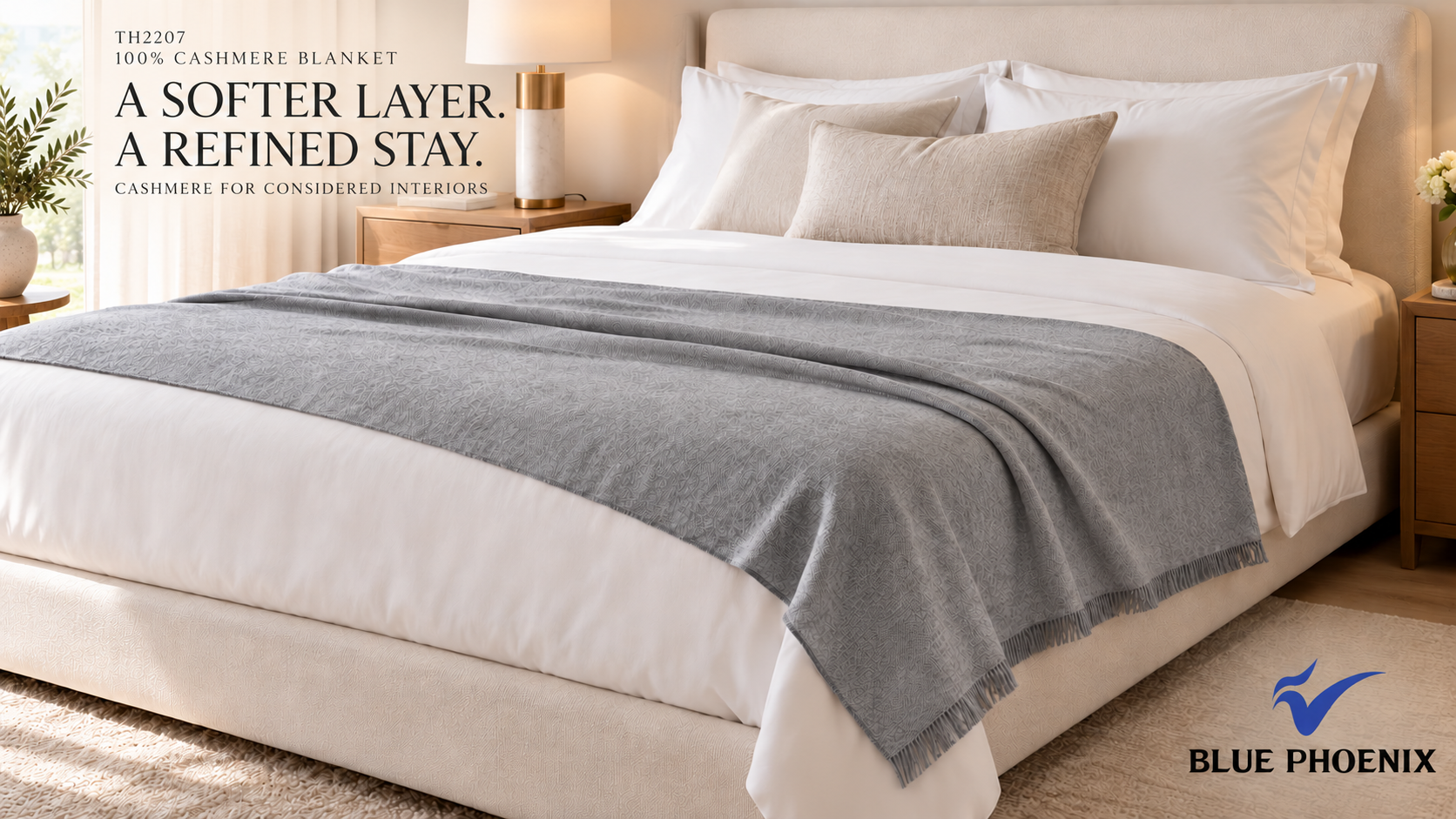
TH2207 Lightweight Cashmere Throw — review grey colour, drape and short fringe.
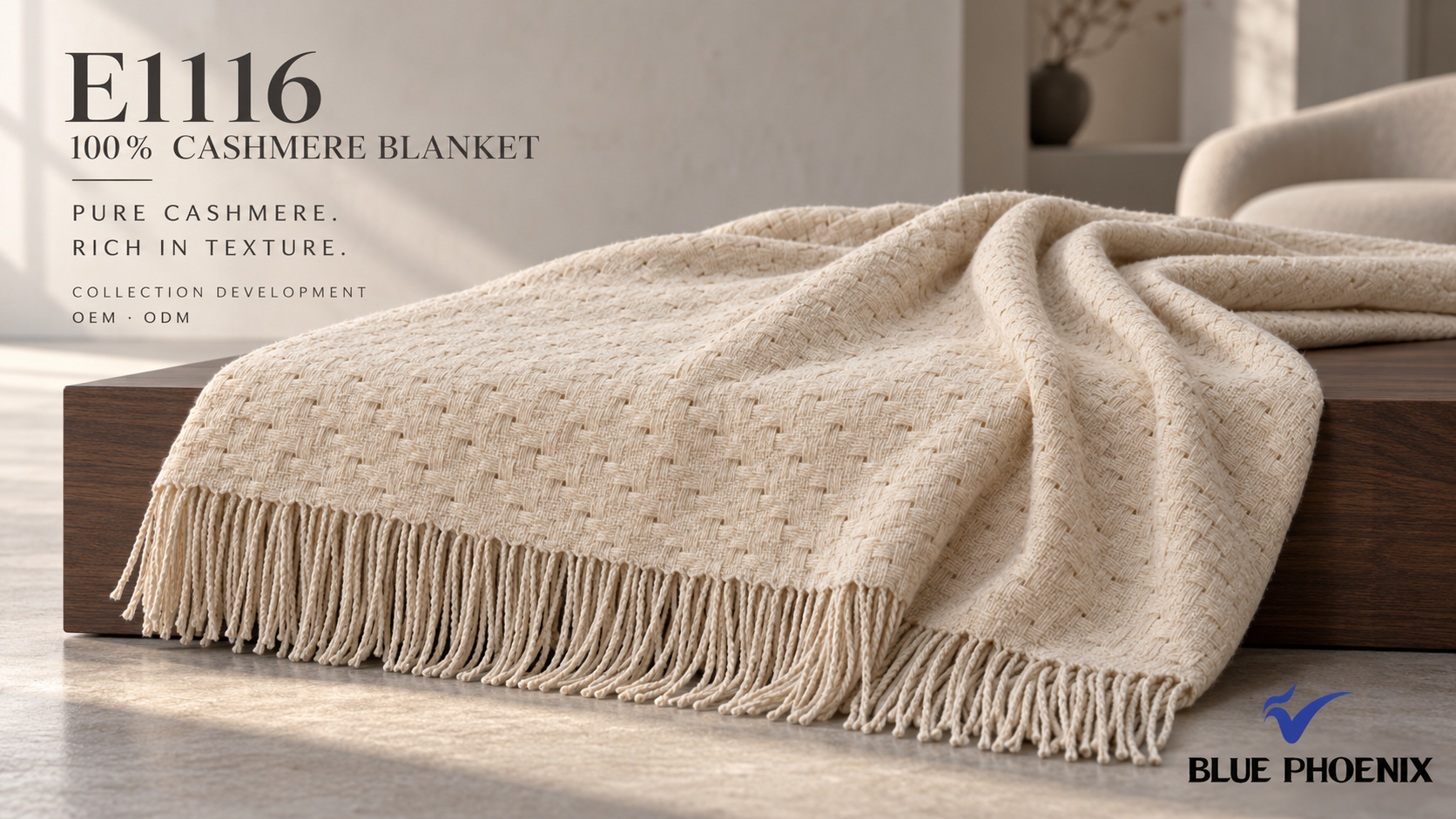
E1116 Textured Cashmere Throw — assess the ivory textured surface.
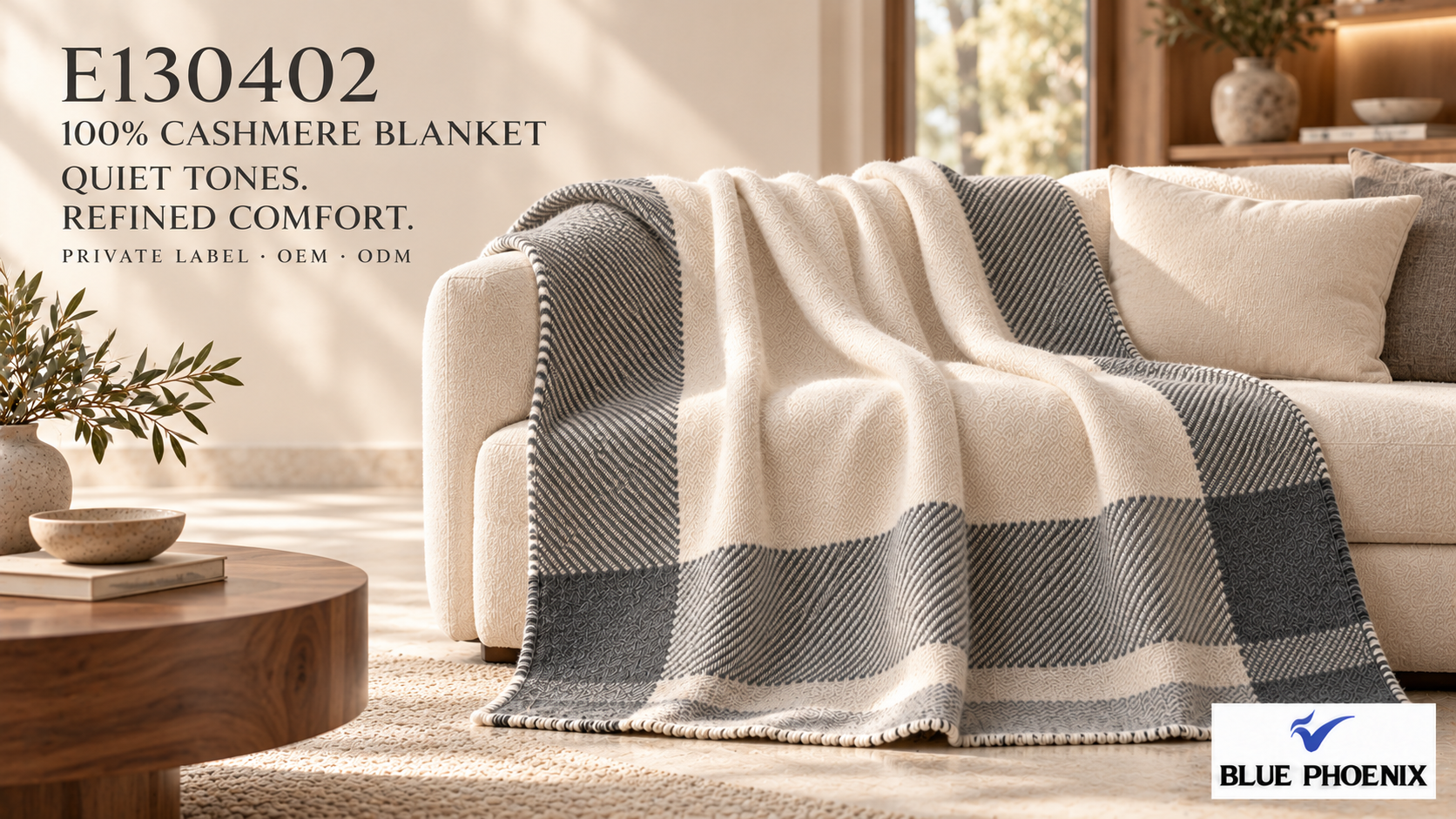
E130402 Border-Check Cashmere Blanket — review border proportions and pattern placement.
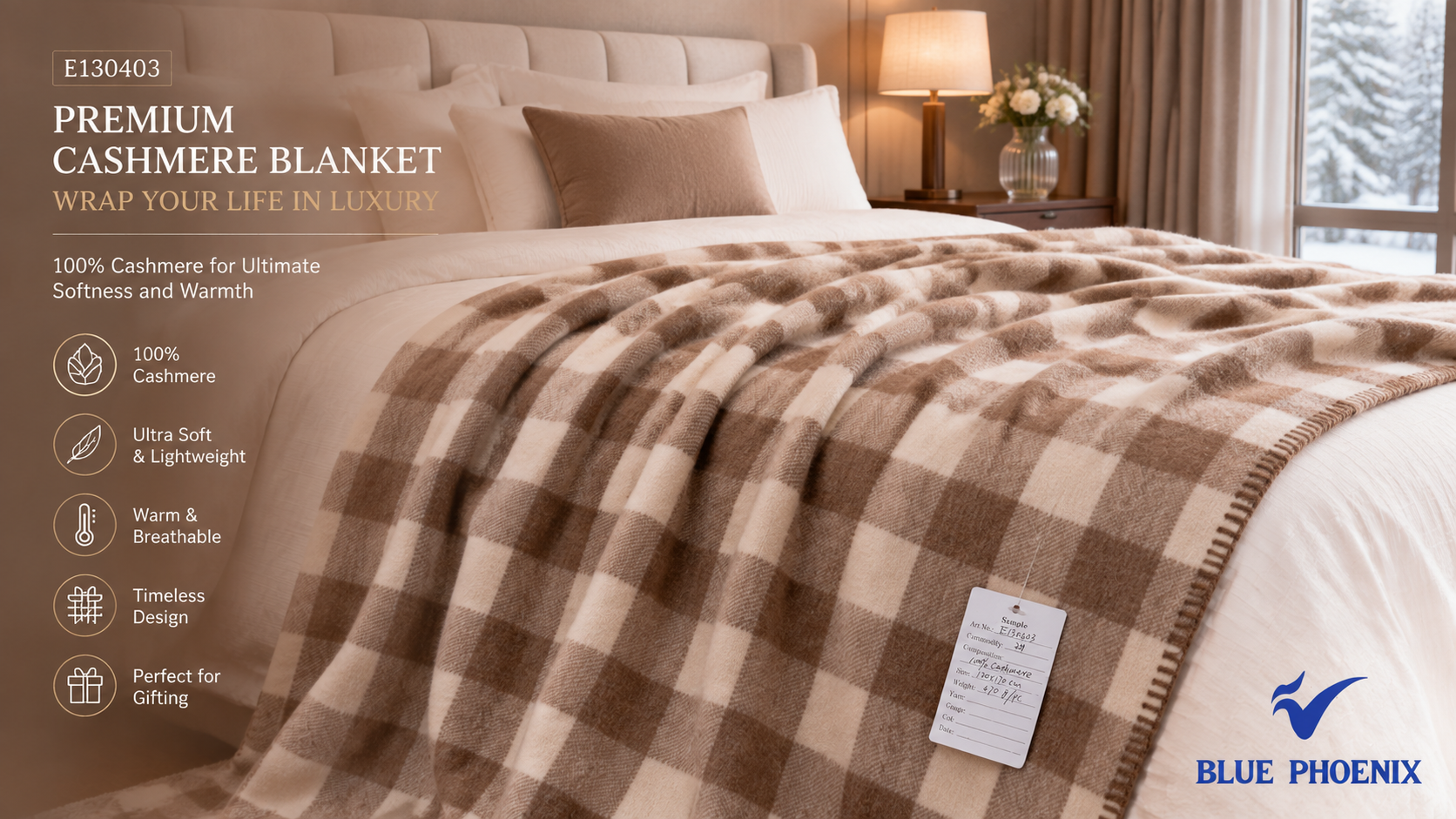
E130403 Natural Cashmere Checkerboard Blanket — compare natural colour contrast and perimeter finishing.
TH2017 Cashmere Blanket with Silk Satin Edge — inspect satin edging and corner workmanship.
BLUE PHOENIX supports OEM, ODM and private-label textile development. Send your intended use, preferred model, composition, dimensions, target weight, colour, quantity, care requirements, labels and packaging brief.
Sample and courier charges apply. Current quotations, minimum quantities and production timing are confirmed according to the selected product and development requirements. Provide any required testing or certification scope before order confirmation.
Website: www.shbluephoenix.com
Email: jamesli@shrainbow.cn
WhatsApp: +86 18017830390
WeChat: bluephoenix66

Blue Phoenix Blankets dedicated to strict quality control of blankets and scarves products and thoughtful customer service, our custom blankets wholesale products are exported to clients in such countries and regions as United states, Europe, Australia, Russia, Germany, Japan.
Copyright © 2026 Shanghai Rainbow Enterprise Development Co., Ltd. - All Rights Reserved.